


Incentives Matter
Incentives are rewards, penalties, and other consequences that influence human choices and behavior.
Human beings respond to incentives.
A reward makes some choices more attractive. A penalty makes some choices less attractive. Profit, loss, praise, embarrassment, promotion, competition, grades, taxes, fines, and countless other consequences can affect the choices an individual makes.
This does not mean incentives determine human behavior mechanically. People sometimes act against their immediate interests because of duty, love, courage, generosity, principle, or poor judgment.
But when the rewards and penalties associated with choices change, behaviors often change with them. That is why economists frequently remind us: Incentives matter.
Different Rules Create Different Incentives
The same human being may behave differently under different circumstances because the incentives have changed.
Consider a business owner spending his own money. If he spends too much, produces something customers do not want, or repeatedly makes poor investments, he bears the losses himself. If he creates something customers value and manages his resources wisely, he may earn a profit.
Competition adds another incentive. Customers can take their money elsewhere.
These incentives encourage attention to cost, quality, efficiency, and customer satisfaction.
Government operates under a different set of incentives. Government agencies ordinarily do not depend upon voluntary purchases from customers for their continued existence, and losses from poor decisions are usually borne by taxpayers rather than personally by the officials making those decisions.
That does not mean government employees are bad people or do not care about doing good work. It means they operate within a different institutional structure, with different rewards, penalties, information, and forms of accountability.
Public-choice economists study precisely these questions: How do political institutions shape the incentives facing voters, politicians, bureaucrats, and interest groups?
Friedman’s Spending Matrix
Milton and Rose Friedman offered a wonderfully simple way to think about how incentives change when people spend money. Within Waypoints, we call it Friedman’s Spending Matrix.
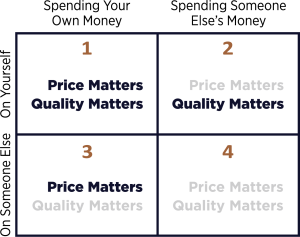
The matrix asks two questions:
- Whose money are you spending?
- On whom are you spending it?
Those two questions create four possibilities.
Quadrant 1: Spending Your Money on Yourself
Imagine buying groceries for yourself with your own money. You care about price because the money is yours. You care about quality because you will eat the food.
You therefore have strong incentives to obtain as much value as possible for what you spend.
Price matters. Quality matters.
Quadrant 2: Spending Your Money on Someone Else
Imagine buying a birthday present for someone. Because you are spending your own money, price still matters.
But because someone else will use the gift, you may have less information about exactly what that person wants and less personal stake in the quality than if you were buying something for yourself.
Price matters most directly. Quality matters less directly.
Quadrant 3: Spending Someone Else’s Money on Yourself
Imagine choosing dinner while someone else has promised to pay the bill. You care about quality because you will eat the meal. But you have less incentive to worry about price because somebody else bears the cost.
Quality matters. Price matters less.
Quadrant 4: Spending Someone Else’s Money on Someone Else
Now imagine spending money that does not belong to you on something that somebody else will receive or use. You personally bear neither the full cost nor the full consequences of the purchase.
The incentives to minimize cost and maximize value are therefore weaker.
Price matters less. Quality matters less.
Friedman used this fourth category to illuminate an important feature of government spending: policymakers spend taxpayer money on programs or benefits intended primarily for other people. The people authorizing the expenditure therefore do not personally bear the full cost or directly experience the quality of what is purchased.
Incentives Are Not Intentions
This distinction is important.
A government official can sincerely want to help people and still operate within incentives that encourage waste or poor decisions. A business owner can be selfish and still face incentives that require him to satisfy customers if he wants their money.
Good intentions and good incentives are not the same thing.
One strand of public-choice theory, for example, has examined whether government agencies sometimes have incentives to seek larger budgets, greater jurisdiction, or institutional security. Other research emphasizes the constraints imposed by legislatures, oversight committees, elections, and other political institutions. The larger point is not that every bureaucrat behaves identically; it is that institutional rules create incentives that affect behavior.
Why Incentives Matter
When evaluating any institution, law, program, business, or policy, it is useful to ask:
What behavior does this arrangement reward?
What behavior does it punish?
Who receives the benefit of a good decision?
Who bears the cost of a bad one?
People do not always respond to incentives predictably, but ignoring incentives makes it much harder to understand human behavior.
Good rules try to align individual incentives with good outcomes. Bad rules can reward precisely the behavior they were intended to discourage.


