Life

Your life is the first and most important property you own.

Life

Wave Image

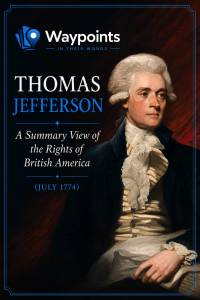
When Thomas Jefferson wrote in the Declaration of Independence that all human beings “are endowed by their Creator with certain unalienable Rights, that among these are Life, Liberty, and the pursuit of Happiness,” he was drawing from a deep tradition of natural rights philosophy, particularly from John Locke and the English Whig tradition.

For Locke, human beings are by nature free and equal. Each person is born with natural rights—not granted by government or society, but inherent in their very existence. Chief among these rights is life. But Locke, and the tradition Jefferson inherited, did not treat “life” as something abstract or separate from the idea of property.

In fact, Locke’s Second Treatise of Government (Chapter V) argues that one’s life is one’s primary property: “every man has a property in his own person; this nobody has any right to but himself.” Your life is your property; your property includes your life. Arguably, your life is the first and most important property you own.

To say that a person’s life is his property is to affirm that no one else—not another individual, not a king, not the government—has a legitimate claim of ownership over his life. Your body, your labor, your thoughts, your time—everything that constitutes you—is fundamentally yours. Without the right to life as property, there can be no meaningful right to liberty or to pursue happiness, because everything else depends on secure ownership of oneself and one’s own life.

Jefferson’s inclusion of life as the first enumerated unalienable natural right highlights its foundational role. If the natural right to one’s own life is unalienable, that right cannot be rightfully taken or surrendered. Governments are instituted, in Jefferson’s words, to secure these rights—not to grant them, not to violate them—and the legitimacy of any government depends on protecting individuals from arbitrary deprivation of life.

This principle radically rejected the older view that rulers could dispose of subjects at will. It declared instead that human beings exist prior to and independent of government, and that each person’s life is his inviolable property.

Seen in this light, the right to life in the Declaration is not merely the right to breathe; it is the recognition that every person owns himself. Self-ownership of one’s own life is the moral foundation for all other rights and the bedrock of a free and just society.
    • United States Constitution

    United States Constitution

    • Thomas Jefferson, Rough Draft of the Declaration of Independence (1776)

    Thomas Jefferson, Rough Draft of the Declaration of Independence (1776)

    • William Lloyd Garrison, “To the Public”

    William Lloyd Garrison, “To the Public”

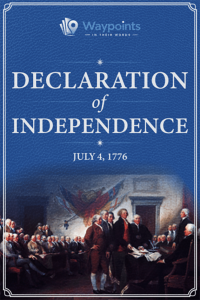
    • Declaration of Independence

    Declaration of Independence

FAQ

Waves

No. Waypoints is not a lesson-plan warehouse. It is a curated library of primary sources paired with tutorials that deepen content knowledge and strengthen instruction. There are no student-facing lesson-plans; there are tutorials for teachers. For teachers, Waypoints is more like graduate school than a set of prepared lesson plans.

The Home Plan is ideal for individual learners and homeschooling families.

Organizer and Educator accounts can access the tutorials. Student accounts cannot.

Waypoints is a digital platform for learning and teaching built around beautifully published Primary Source Documents and Teacher Tutorials that reinforce selected Key Ideas of Liberty.

The Home Plan is $199 per year and includes an Organizer account, up to two Educator accounts, and up to four Student accounts.

Yes. Many people use the Home Plan simply for their own access to the Library and Tutorials. If you are a lifelong learner, the Home Plan is for you.

No. The purchase process automatically creates your Organizer account, which includes full access to all Waypoints content.

A Custom Plan is for schools, organizations, or other users whose needs are not fully met by a Home Plan or an Academy Plan. It can include a tailored combination of Educator and Student accounts. Please contact us for a Custom Plan proposal.

Student accounts can access the Library of primary source documents.

Yes, please do! We encourage teachers to use Tutorial content, written or video, any way they find helpful.

The Academy Plan is designed for schools, school districts, and other educational organizations.

For schools and districts, pricing is based on student enrollment. For non-school organizations and businesses, pricing is based on membership or staff size.

Please use the Contact Us page to discuss pricing, onboarding, and implementation.

Educators receive tutorials that illuminate the documents, deepen subject-matter knowledge, and support stronger classroom instruction.

You can go to the Waypoints Library and see the list of titles we have curated stretching across subjects such as American history, political thought, philosophy, economics, and citizenship.

Not yet. Additional titles are being prepared and published on a rolling basis. We will let members know when as more documents are published and uploaded to the Library.

Yes. Waypoints is designed to enrich and elevate existing instruction, especially in history, civics, government, and related courses. A teacher does not need to abandon the textbooks, lesson plans, or other curricula materials that have been used for past instruction. Waypoints is designed as an add-on to the materials teachers have been using and assigning to students.