Waypoints helps you study and teach America’s essential documents—and the ideas behind them.
Waypoints is a unique civic education resource. Explore beautifully publishedprimary sources accompanied by written and video tutorials.
The subjects?
 American history.
- Political philosophy.
- Economics.
- Liberty.
- The challenge of self-government.
The Waypoints Library brings you closer to the individuals who shaped theAmerican experiment—in their own words.
Waypoints helps you study and teach America’s essential documents—and the ideas behind them.
Waypoints is a unique civic education resource. Explore beautifully published primary sources accompanied by written and video tutorials.
The subjects?
-
 American history.
-
Political philosophy.
-
Economics.
-
Liberty.
-
The challenge of self-government.
The Waypoints Library brings you closer to the individuals who shaped the American experiment—in their own words.
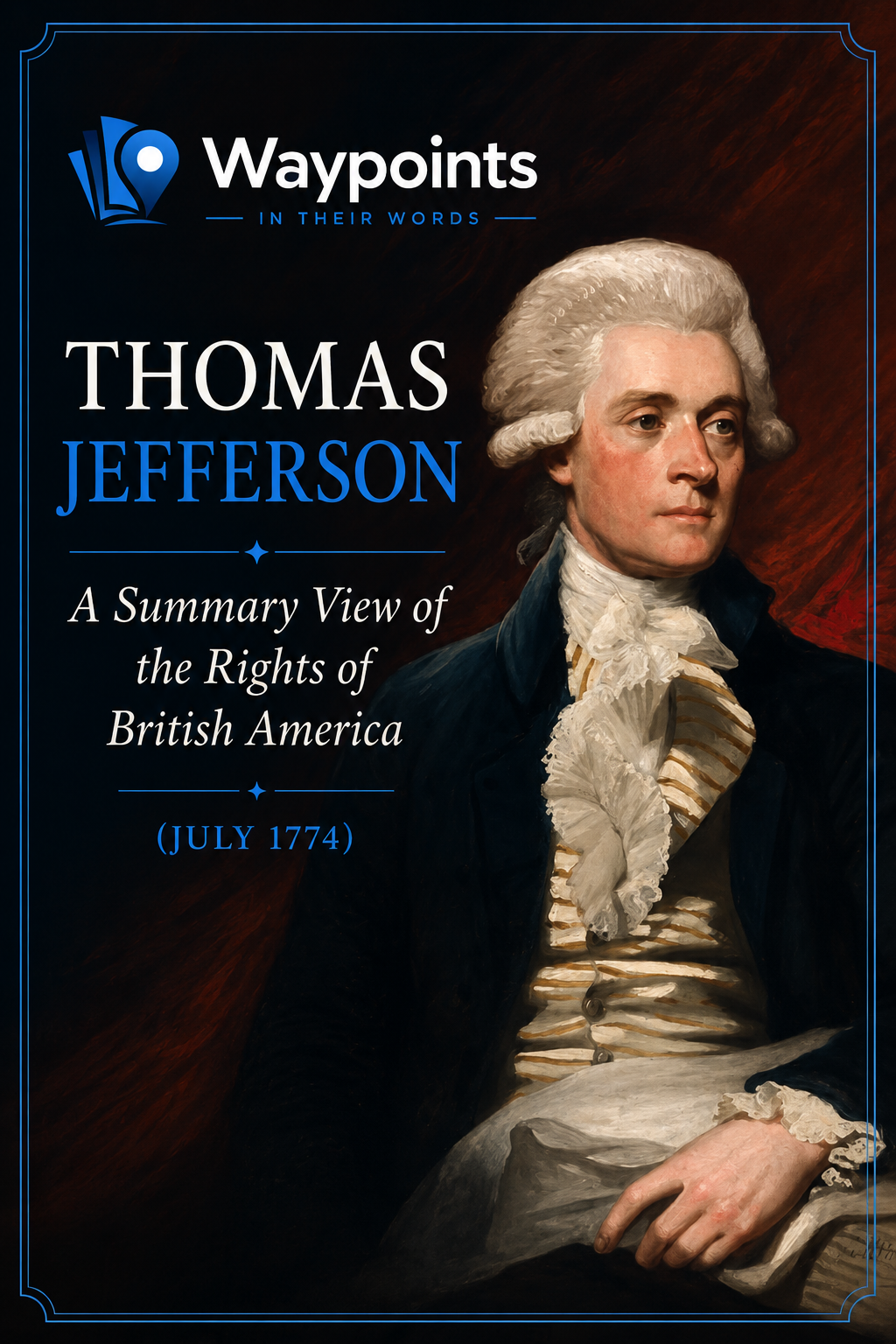
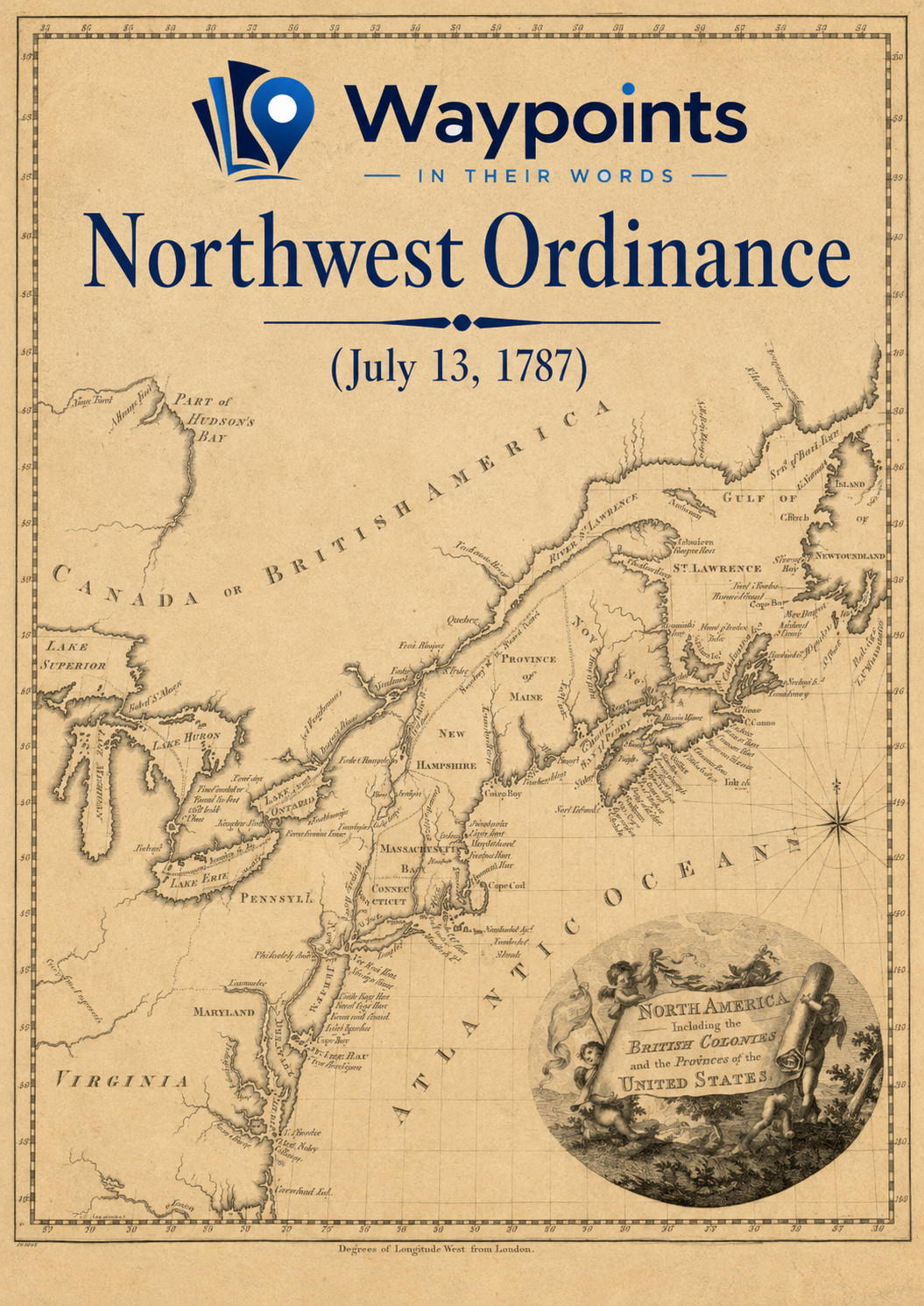



Helpful answers, thoughtfully gathered
Waypoints at a Glance
Popular Questions
Find answers to our most frequently asked questions.
Waypoints is an online educational resource built around important primary-source documents and the ideas they contain. The Waypoints Library features a carefully curated collection of pivotal works in American history, government, political philosophy, and economics, accompanied by graduate-level written and video tutorials designed to help teachers and independent learners understand them more deeply.
Waypoints is supplemental by design: use as much or as little as you need, wherever it adds value to what you are already teaching or studying.
No. Waypoints is intentionally designed as a supplemental educational resource, not a prescribed curriculum. While we offer suggested courses of study for different users, there is no required sequence, pacing schedule, or course you must follow. Teachers, schools, homeschoolers, and independent learners are free to select the documents and tutorials that best fit what they are teaching, studying, or exploring.
This flexibility allows Waypoints to strengthen an existing history, government, civics, philosophy, or economics course without requiring you to replace what is already working.
Not primarily. Waypoints is designed first to help educators understand important primary sources and the ideas behind them so they can teach those materials with greater knowledge and confidence.
Many Waypoints tutorials include discussion questions, writing assignments, key passages, teaching suggestions, and suggested lessons. But Waypoints does not assume that every teacher should teach every document in the same way. We provide serious intellectual preparation along with practical teaching resources; you decide what works best for your classroom.
Waypoints is for anyone who wants to study or teach important ideas through the words of the people who shaped, debated, and defended them.
It is designed especially for classroom teachers, schools and districts, homeschooling families, and individual learners. Whether you are preparing tomorrow's history lesson, strengthening a civic education program, teaching your children at home, or simply trying to understand the American political tradition more seriously, Waypoints gives you direct access to primary sources and resources for carefully analyzing and interpreting them.
The Waypoints Free Trial gives you two weeks to explore selected primary-source documents and related Waypoints tutorials. You can see how the documents are published in the Library and explore the written and video tutorials that help explain their historical setting, arguments, major ideas, and significance.
There is no credit card required and no obligation to purchase anything. The purpose of the Free Trial is simple: we want you to have enough time to explore Waypoints and decide whether it provides value for you.
That depends on how you plan to use Waypoints.
- The Home Plan is designed for individuals and households, including teachers, homeschoolers, and individual learners.
- The Academy Plan is designed for schools, districts, and other educational organizations that want to provide Waypoints access to multiple teachers and students.
- If your needs do not fit neatly into either option, we can create a Custom Plan.
If you are ready to purchase a Home Plan, you can do so online now: Home Plan .
If you are unsure, contact us . Tell us how you'd like to use Waypoints, and we will help you identify the simplest and most appropriate option.
Waypoints is supplemental by design. You do not need to reorganize your course, adopt a new curriculum, or teach the Waypoints Library in any prescribed sequence.
Instead, select the primary-source documents and tutorials that fit what you are already teaching. A history teacher might use one document to deepen a unit on the American Founding, slavery, the Civil War, or Progressive reform. A government teacher might use several documents to explore constitutionalism, federalism, natural rights, or the separation of powers. Teachers of civics, political philosophy, and economics can use Waypoints in much the same way.
Use one document, several documents, or an entire suggested course of study. Waypoints is designed to strengthen what you already do well.
Waypoints teacher tutorials are designed to provide serious intellectual preparation for teaching important primary sources. Depending on the document, tutorials may include historical and intellectual context, an overview of the argument, close analysis of important passages, major themes, connections to other documents and ideas, discussion questions, short writing assignments, and suggested lessons.
Many documents also include video tutorials, giving teachers an opportunity to study the material much as they might in an advanced seminar.
The tutorials are not scripts that tell you exactly what to say. They are resources designed to deepen your own understanding and give you useful material from which to teach. You are free to use the tutorial materials in whatever ways you find helpful—as lecture notes, to present passages on a classroom screen, to guide classroom discussions, or to use suggested lesson activities with students.
Important primary sources can be difficult. Their authors often assume historical knowledge their original audiences possessed, use unfamiliar language, develop complicated arguments, or refer to political and philosophical controversies that are not immediately obvious to modern readers.
Waypoints does much of that preparatory work for you. The tutorials provide context, identify central arguments and ideas, call attention to significant passages, and help explain why a document matters.
The goal is not merely to provide classroom activities. It is to help you approach important texts with greater knowledge and confidence so that you can help your students read, question, discuss, and understand them more seriously.
Yes. Waypoints is designed so that students can engage directly with the primary sources themselves.
With student access, students can enter the Waypoints Library and read the published primary-source documents their teacher asks them to study. Teacher-facing tutorials and instructional resources remain available only to educators, allowing teachers to prepare with more extensive material while students encounter the historical sources directly.
This reflects a central principle of Waypoints: whenever possible, students should encounter important thinkers and historical figures in their own words.
Waypoints is especially useful for courses in American history, United States government, civics, political philosophy, and economics. Because the Library is organized around primary sources and enduring ideas rather than around a single textbook or curriculum, many documents can be used across several subjects.
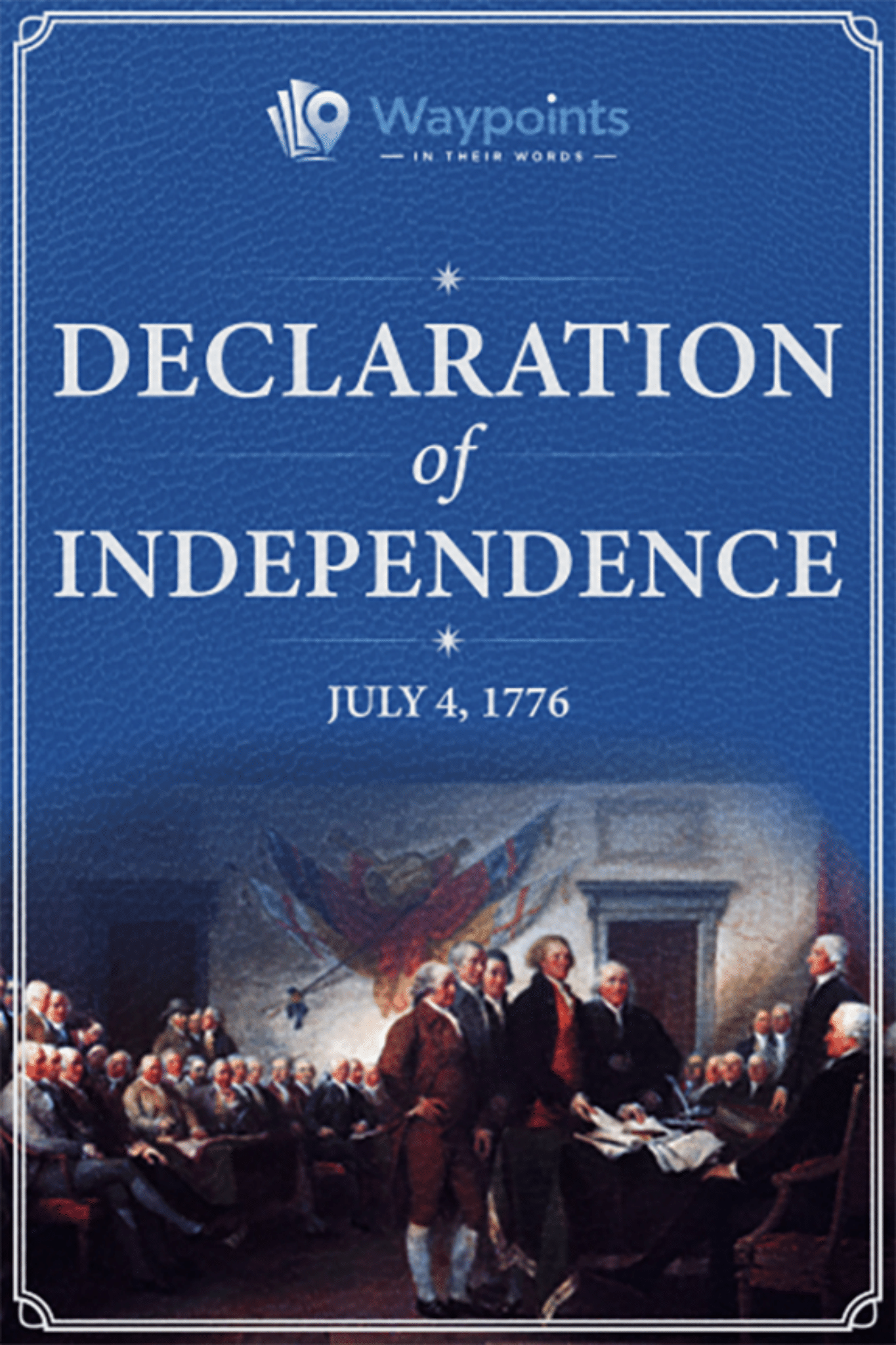
A document such as the Declaration of Independence, for example, can be studied historically, constitutionally, philosophically, and politically. Other materials illuminate questions involving slavery and abolition, religious liberty, federalism, citizenship, political economy, constitutional interpretation, and the meaning of self-government.
Teachers can therefore use Waypoints selectively within an existing course or draw upon larger groups of documents to build more sustained courses of study.
No. In fact, helping teachers develop deeper subject-matter knowledge is one of the principal purposes of Waypoints.
A teacher should not need to be a specialist in political philosophy to teach Locke, an expert on constitutional law to teach Madison, or a Lincoln scholar to help students understand the Gettysburg Address. Waypoints tutorials are designed to make demanding primary sources accessible while preserving their intellectual seriousness.
The tutorials provide graduate-level depth without assuming graduate-level expertise on the part of the user. Whether a document is already familiar to you or you are encountering it for the first time, Waypoints can help you study it carefully before bringing it into the classroom.
Waypoints is designed to strengthen existing courses and programs without requiring a school or district to adopt a new curriculum.
Schools can use Waypoints within American history, government, civics, political philosophy, economics, and related courses. One teacher might use a few primary sources during the year, while a department or district might draw more extensively from the Library across several courses and multiple high school grade levels, as well as in strong middle school programs.
Because Waypoints is supplemental by design, educators remain free to select the documents, tutorials, and suggested lessons that best serve their students and fit what they are already teaching.
Waypoints treats teacher knowledge as an essential part of good education. The teacher tutorials are designed not merely to provide classroom activities, but to help teachers deepen their own understanding of important historical documents, arguments, and ideas.
Written and video tutorials provide historical and intellectual context, close textual analyses of important passages, explanations of major themes, connections and comparisons among documents and thinkers, and practical teaching resources. Teachers can use these materials independently, with colleagues, or as part of a broader professional-development effort.
In this sense, Waypoints provides two kinds of value at once: primary-source materials for students and serious continuing education for the teachers who teach them.
Yes. The Waypoints Library includes materials relevant to American history, United States government, civics, political philosophy, economics, and related subjects.
Many documents naturally cross disciplinary boundaries. The Declaration of Independence, for example, is simultaneously a historical document, a statement of political philosophy, an argument about legitimate government, and a foundational text of American civic life. Paine’s Common Sense and Lincoln’s Lyceum Address can enrich an English or rhetoric class no less than a history or social studies class. Many documents in the Waypoints Library may likewise enrich more than one course.
A school or district can therefore use Waypoints selectively within individual classrooms or more broadly across departments and programs.
Waypoints provides different levels of access for educators and students.
Educators receive access to the Waypoints Library along with teacher-facing written and video tutorials, discussion questions, writing assignments, suggested lessons, and other instructional resources. Students receive access to the published primary-source documents so they can engage directly with the texts teachers assign for study.
This separation allows teachers to prepare with deeper instructional material while keeping the student experience centered on the primary sources themselves.
The Academy Plan is designed for schools, districts, and other educational organizations that want to provide Waypoints access to multiple teachers and students.
An Academy Plan can provide educators with access to the Waypoints Library and teacher tutorials while also providing student access to the primary-source collection. Because schools and districts vary considerably in size, structure, and intended use, Academy Plans can be tailored to the needs of the institution.
Rather than forcing every school into the same package, we encourage schools and districts to contact us so we can learn how they hope to use Waypoints and recommend an appropriate arrangement.
Yes. We welcome conversations with schools and districts considering Waypoints.
We can provide a demonstration of the Waypoints Library and tutorials, answer questions about educator and student access, and discuss how Waypoints might fit within your existing history, government, civics, or related programs.
Tell us a little about your school or district, the educators and students you hope to serve, and how you imagine using Waypoints. We will be happy to discuss an Academy Plan or, when appropriate, a Custom Plan designed around your needs.
Yes. Waypoints is especially well-suited to homeschooling because it is flexible, supplemental, and built around primary-source documents rather than a prescribed curriculum.
You can use Waypoints alongside a curriculum you already like, incorporate individual documents into particular units, or draw more extensively from the Library to build a larger course of study. The teacher tutorials provide historical context, close textual analyses, discussion questions, writing assignments, suggested lessons, and other resources that can help a parent prepare to teach serious material with confidence.
Waypoints is designed to help you teach important ideas without requiring you to surrender control over what, when, or how you teach.
Waypoints was designed primarily with high school-level instruction in mind. The documents and tutorials deal seriously with history, government, civics, moral and political philosophy, economics, and other subjects that are especially appropriate for students preparing for college and adult citizenship.
Many Waypoints materials can also work well with strong middle-school students, particularly when a parent or teacher provides additional guidance and selects documents appropriate to the student’s reading level and interests.
Because Waypoints is supplemental, families can decide which materials are appropriate for each child rather than being required to follow a fixed grade-level sequence—one of the particular virtues of homeschooling.
You do not need to replace a homeschool curriculum you already value. Waypoints is designed to strengthen what you are already doing.
If your curriculum includes the American Founding, for example, you might add the Declaration of Independence, selections from The Federalist Papers, or Washington’s Farewell Address and use the related tutorials to prepare for discussion. A course on slavery and the Civil War might be enriched with documents by Jefferson, Frederick Douglass, Stephen A. Douglas, Lincoln, and others. Similar opportunities exist in government, civics, political philosophy, economics, and related subjects.
We encourage homeschooling families to be creative in their pedagogical and curricular choices. Consider, for example, adding Paine’s Common Sense, Jefferson’s First Inaugural Address, or Lincoln’s Lyceum speech to an English unit on rhetoric or persuasion.
You can use one Waypoints document when it adds value, several documents within a unit, or a larger suggested course of study. The choice remains yours.
That is an important reason Waypoints exists.
You do not need to begin as an expert on Locke, Madison, Lincoln, constitutional government, political philosophy, economics, or the many other subjects covered in the Waypoints Library. The teacher tutorials are designed to help you prepare by explaining historical context, identifying central arguments and ideas, walking through difficult passages, and providing questions and teaching suggestions you can use with your student.
Homeschooling parents take on an enormous educational responsibility. Waypoints cannot teach every subject your child needs, but in the areas we cover, we are here to help you carry that responsibility with greater knowledge and confidence.
And you may discover something else along the way: as you prepare to teach your child, you may find yourself learning just as much, maybe even more.
Yes. Although Waypoints is not a prescribed curriculum, the Library contains substantial groups of documents that can serve as the foundation for serious courses of study.
A homeschool family might build a course around the American Founding, constitutional government, slavery and abolition, political philosophy, economics and citizenship, or other themes represented throughout the Library. Waypoints also offers suggested courses of study that can help families organize documents into meaningful sequences.
You remain free to add textbooks, literature, lectures, writing assignments, outside readings, or other resources of your choosing. Waypoints provides the primary sources and intellectual preparation; you determine how extensive the course should be and how it fits within your larger homeschool program.
There is another benefit. Many documents in the Waypoints Library rightfully belong among the Great Books of the Western tradition—texts that reward repeated study with deeper insight and understanding. The curricular freedom of homeschooling makes it possible to introduce Aristotle’s Ethics or The Federalist Papers at age 14 or 15, then return to those same works for deeper study at 17 or 18.
Yes, particularly as students become older and more capable readers.
With student access, students can enter the Waypoints Library and read the published primary-source documents directly. Parents and other educators have access to the more extensive teacher-facing tutorials and instructional resources, allowing them to prepare for discussions, assignments, and lessons while students engage with the original texts themselves.
Some high school students may be able to work through assigned documents largely independently, while others will benefit from more discussion and guidance. Homeschool families can decide how much independence is appropriate for each student. Some families may find that older students benefit from access to the tutorials as well. In those cases, they can use educator access where their plan allows.
The goal is not to place another intermediary between the student and the great texts, but to help students encounter important thinkers and historical figures in their own words.
Yes. Waypoints is for anyone who wants to study important primary sources and the ideas they contain.
You do not need to teach a class, belong to a school, or be enrolled in a formal course. individual learners can use the Waypoints Library and related tutorials for independent study, intellectual enrichment, or simply the pleasure of reading important works more carefully.
Waypoints invites independent learners to join what has often been called the Great Conversation: the centuries-long exchange among thoughtful men and women about enduring questions of justice, liberty, virtue, equality, government, citizenship, and how human beings ought to live.
Begin wherever your curiosity takes you.
You might start with a familiar document such as the Declaration of Independence, Washington’s Farewell Address, or Lincoln’s Gettysburg Address and discover how much more there is to understand beneath the surface. You might follow a particular thinker, explore a theme such as natural rights or self-government—our Key Ideas of Liberty and related documents are particularly good for that—or work through one of the suggested courses of study available in Waypoints.
There is no required starting point and no prescribed sequence. If you are not sure where to begin, our suggested courses of study can provide a path while leaving you free to depart from it whenever another question or document captures your interest.
And, of course, one can always begin at the beginning: The first document in the Waypoints Library is the Mayflower Compact. Before assuming you know all there is to know, spend some time with our beautifully published version and related tutorials. Even better: let us know what you think.
The Waypoints Library features a carefully curated collection of primary sources from American history, government, moral and political philosophy, economics, and the broader Western intellectual tradition.
You can study foundational American documents alongside works by thinkers such as Aristotle, Locke, Madison, Jefferson, Washington, Lincoln, Smith, and many others. The Library explores subjects including natural rights, constitutional government, liberty, equality, virtue, slavery and abolition, religious freedom, citizenship, political economy, and the meaning of self-government.
The aim is not merely to collect old documents. Waypoints brings together texts that illuminate one another and help readers think more seriously about enduring human questions beginning with the most fundamental: How should I live?
The primary sources remain at the center of Waypoints. The tutorials are designed to help you read them more carefully and understand more of what is there.
Written and video tutorials serve as guides. They provide historical and intellectual context, explain difficult arguments, call attention to important passages, identify major themes, and trace connections and disagreements among thinkers and documents. They can help make unfamiliar works more accessible while also revealing greater depth in texts you may already know.
The goal is not to replace the original author with someone else’s summary. It is to help you return to the primary source better prepared to understand, question, and evaluate it for yourself.
No. Intellectual curiosity is enough to begin.
You do not need formal training in history, government, economics, or political philosophy to study the materials in Waypoints. The tutorials are designed to provide much of the background needed to approach demanding texts without reducing those texts to oversimplified summaries.
Whether you are reading Aristotle for the first time, returning to the Declaration after many years, or trying to understand a constitutional argument you have never studied before, Waypoints can help you enter the conversation at your present level and continue going deeper.
Absolutely. There are no deadlines, required sequences, grades, or courses you must complete.
You might spend an evening with a single speech, devote several weeks to one thinker, follow an idea such as liberty or equality across many documents, or work systematically through a suggested course of study. You can return to important works repeatedly as your interests and understanding develop.
That freedom is especially appropriate to individual learning. The Great Conversation is not something one finishes. The best books and documents often become more rewarding as we return to them with greater experience, better questions, and a deeper understanding of the ideas at stake.
Begin wherever your curiosity takes you.
You might browse the Waypoints Library and browse the full catalog of titles we have curated. You might visit the Key Ideas of Liberty on the Premises page and explore the principles around which Waypoints is organized. You might begin with the Great Conversation essay in our Blog and consider the enduring question that gives Waypoints much of its intellectual direction: How should I live?
There is no required starting point. Explore freely. If something catches your attention, follow it.
The Waypoints Library features a carefully curated collection of primary-source documents in American history, government, moral and political philosophy, economics, and the broader Western intellectual tradition.
You will find foundational American documents alongside works by thinkers such as Aristotle, Locke, Jefferson, Madison, Washington, Lincoln, Smith, and many others. The collection includes speeches, essays, letters, sermons, political writings, philosophical works, constitutional documents, and other texts that illuminate important historical events and enduring ideas.
Many documents are accompanied by written and video tutorials designed to help educators and independent learners study them more carefully.
Because important thinkers deserve to be encountered in their own words.
Learning about Jefferson, Madison, Lincoln, Locke, Aristotle, or Smith through someone else’s summary can be misleading. Sometimes summaries are useful. Sometimes they are skewed. Sometimes they omit what an original author thought was important but a later scholar ignores as trivial. Secondary commentary inevitably filters the original author through another person’s interpretation.
Waypoints begins with the primary source whenever possible. Read the argument. Examine the language. Consider the evidence. Ask whether the author is right. Then use the tutorials and other resources to help deepen your understanding.
That is the idea behind our tagline: In Their Words.
Waypoints tutorials are designed as guides for serious study.
Depending on the document, a tutorial may provide historical and intellectual context, explain the structure of an argument, offer close textual analysis of important passages, identify major themes, connect the document to other thinkers and texts, and suggest questions for further reflection.
Teacher-facing tutorials may also include discussion questions, writing assignments, and suggested lessons. Many documents include video tutorials as well.
The purpose is not to replace the primary source with a summary. The tutorial should help you return to the original text better prepared to understand and evaluate it for yourself. The Waypoints way is to approach important historical documents as respectful students, open to the possibility that earlier thinkers may have something important to teach us, rather than assuming we are wiser simply because we were born in more modern times.
Waypoints combines several things that are not often found together.
The Library is carefully curated rather than designed simply to be enormous. Primary sources remain at the center. The related tutorials offer graduate-level intellectual depth while remaining accessible to people who may be encountering the material for the first time. And Waypoints is supplemental rather than prescriptive: we provide serious materials and guidance without telling every teacher, family, or learner that the same sequence or method must be followed.
Waypoints also treats history as more than a collection of dates and events. The documents invite readers into larger questions about liberty, equality, justice, virtue, citizenship, constitutional government, political economy, and self-government.
In that sense, Waypoints is not merely about studying the past. It is about using the best texts from the past to think more seriously about enduring human questions that remain deeply relevant today.
Yes. That is precisely why we offer the Waypoints Free Trial.
The Free Trial gives you two weeks to explore selected primary-source documents and related tutorials so you can see how the Library works, examine the quality and depth of the materials, and decide whether Waypoints provides value for you.
There is no credit card required and no obligation to purchase anything.
We would rather have you spend some time inside Waypoints, look around carefully, and decide for yourself.
Starting a Waypoints Free Trial is simple. Register for a Free Trial through the Waypoints website and create your login credentials. No credit card is required.
Your Free Trial gives you two weeks to explore selected primary-source documents and related written and video tutorials so you can experience Waypoints before deciding whether to purchase a plan.
After registering, watch for an email from Waypoints with information about your access. If you do not see it in your inbox within a few minutes, check your spam, junk, promotions, or other filtered-email folders.
When your two-week Free Trial ends, your trial access expires automatically. There is nothing to cancel, and you will not be charged.
If you would like to continue using Waypoints, you can purchase a Home Plan online. Home Plan Purchase , Schools, districts, and other educational organizations can contact us to discuss an Academy Plan or Custom Plan.
If you are unsure which option is right for you, contact us and tell us how you would like to use Waypoints. We will be happy to help.
Waypoints provides different kinds of access for educators and students.
Educator accounts provide access to the Waypoints Library along with the teacher-facing written and video tutorials, discussion questions, writing assignments, suggested lessons, and other instructional resources.
Student accounts are designed to keep the student experience centered on the primary sources themselves. Students can enter the Waypoints Library and read the published documents their teachers or parents ask them to study. Students do not see the tutorial options.
This allows educators to prepare with deeper instructional resources while students encounter important thinkers and historical figures directly in their own words.
If your Waypoints plan includes additional educator or student access, you can invite other people to create their own Waypoints accounts.
From your Waypoints Dashboard, you will find separate registration options for educators and students. Share the appropriate registration link with the people you want to add. Each person registers individually and creates his or her own unique login credentials.
Be sure to use the educator option only for people who should have access to teacher-facing tutorials and instructional resources. Students should register using the student option.
First, make sure you are using the same email address you used when you registered for Waypoints.
If you are waiting for a registration, password, or account email, check your spam, junk, promotions, and other filtered-email folders. Automated emails sometimes land there rather than in the primary inbox.
If you still cannot access your account, use the Contact Us page and send us a note. Contact UsInclude the email address associated with your Waypoints account and a brief description of the problem so we can help you resolve it.
If your needs change, contact us.
Perhaps you started with a Home Plan and now want to use Waypoints with a school, co-op, or larger group. Perhaps your school needs additional educator or student access. Or perhaps you simply have a question about your existing account.
Use the Contact Us page and tell us what you need. Contact Us We will help you determine whether your current plan still makes sense or whether an Academy Plan, Custom Plan, or other arrangement would serve you better.
Still have a question?
Our team is here to help you find the right path forward.