Table of Contents
ToggleAt Waypoints, we provide civic education resources that feature primary sources for high school teachers. The Declaration of Independence occupies a position of central importance in all we do, which is why we are pleased to contribute to the 250th Anniversary celebrations.
By Thomas L. Krannawitter, Ph.D.
After a hot, hazy day, the night air turned muggy and smelled of dust, sweat, and cigarettes. Smoking was popular. It was one of the few activities allowed. In a vast concrete square, thousands of students sat cross-legged on the hard ground, hungry, tired. After weeks of protest they were weary and weather-worn, yet steadfast in their cause—freedom. Their young faces bore that peculiar mix of resolve and disbelief that appears when ordinary life is punctuated by a historic event.
From the distance emerged a distinct sound: the low, mechanical growl of engines. At first it was easy to mistake for thunder or an earthquake. But it grew steadier, heavier, louder, accompanied by the clatter of metal tracks.
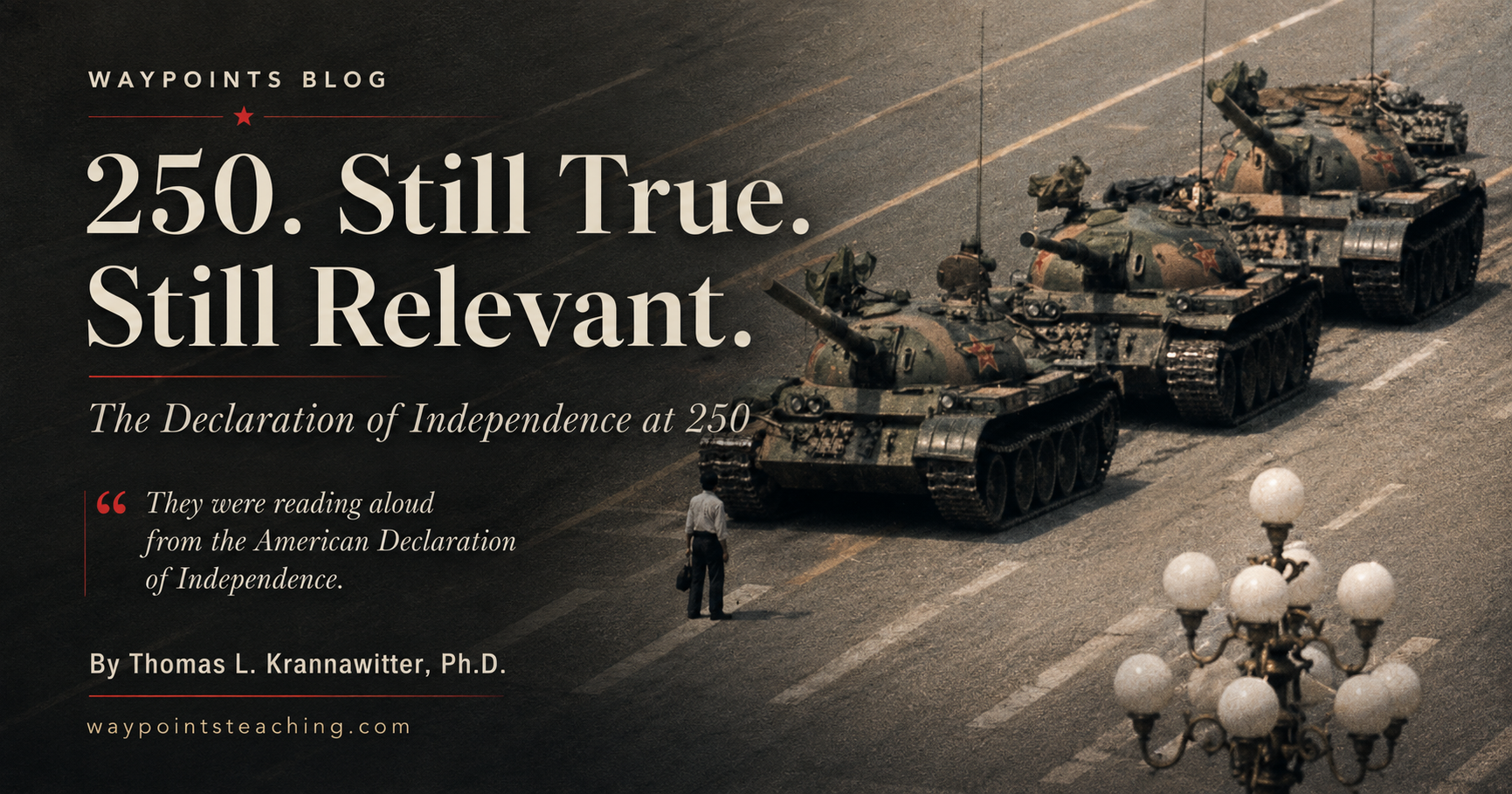
Tanks soon appeared under the streetlights, their dull green shapes advancing with slow, methodical indifference toward the crowd before them. Students stood. Some raised their hands instinctively. Some cried out. Others froze in fear.
The tanks were not there to debate or argue. Their presence instantly transformed a place of assembly into an arena of submission and compliance. Those who had gathered to speak as citizens were instantly reminded that they were, in fact, subjects.
Soldiers began shooting unarmed students in large numbers. To this day, we do not know whether the murder toll numbered in the hundreds or thousands. Independent and mostly foreign journalists had been expelled before the slaughter commenced—removed not by chance, but by design.
The place was Tiananmen Square in Beijing, China. The year was 1989. And why did the communist Chinese government mow down unarmed young people with tanks and machine guns that fateful night? What were those students reciting in public that so angered—or threatened—the Politburo of the Chinese Communist Party?
They were reading aloud from the American Declaration of Independence.
Self-Evident
Despots should quake when they hear the immortal words of the Declaration of Independence—which signaled the birth of a new nation of liberty. The practical application of the Declaration can, in certain conditions, require violent revolution against those who wield government power for the purpose of violating rather than protecting the natural rights of the people.
“A Prince whose character is thus marked by every act which may define a tyrant,” the Declaration ominously warns, “is unfit to be the ruler of a free people.” This follows the earlier pronouncement that when “a long train of abuses and usurpations… evinces a design to reduce [a people] under absolute despotism, it is their right, it is their duty, to throw off such government.”
This is not the language of timid subjects. It is not how those who view unquestioning submission and compliance as civic virtues, talk. It is the language of spirited, liberty-loving men and women who refuse to cower before fear-driven, small-souled tyrants with outsized egos.
The beauty of the Declaration of Independence is inseparable from its timelessness and universality. The truths it proclaims really are self-evident. And like all self-evident truths, they remain true regardless of how many people understand or affirm them.
Consider, for example, the Pythagorean Theorem—a self-evident truth of geometry. It is true that squaring the legs of a right triangle and adding them together always equals the square of the hypotenuse.
A² + B² = C² was true long before human beings discovered or knew it. It was true the day Pythagoras proved it deductively as a universal proposition. It remains true today, when millions learn it in high school geometry classes. The Pythagorean Theorem is true whether understood by many, a few, or no one.
The truthfulness of any self-evident truth is not contingent upon how many people understand it, agree with it, affirm it, or vote for it. Truth is not a popularity contest.
In precisely the same way, the moral-political truths articulated in the Declaration of Independence are eternal, unchanging, and universal. Some people understand and affirm them; others do not. Some attempt to align their political policies and personal conduct with those principles; others ask dismissively, “Why bother?”
Regardless of opinion, it remains true:
- that “all men are created equal” in the sense that every human being is equally human—and to be human is to possess the natural capacity for self-government;
- that every human being has an unalienable rightful claim, by nature, to one’s own life, liberty, and the pursuit of happiness;
- that the proper purpose of government is to secure those rights and political legitimacy requires the consent of the governed.
In an 1857 commentary on the Declaration of Independence, Abraham Lincoln explained:
[T]he authors of that notable instrument intended to include all men, but they did not intend to declare all men equal in all respects. They did not mean to say all were equal in color, size, intellect, moral developments, or social capacity. They defined with tolerable distinctness, in what respects they did consider all men created equal—equal in “certain unalienable rights, among which are life, liberty, and the pursuit of happiness.” This they said, and this they meant.
Those who deny these truths resemble modern-day flat-earthers—but worse. They deny the very standard by which unjust laws and illegitimate governments are judged.
Critics who insist that the principles of the Declaration are outdated, irrelevant, or untrue are insisting they and we—you and I—have no natural rightful claim to our own lives, liberties, and property.
That is not merely foolish; it is dangerous.
Rejecting the Declaration to Promote Bad Causes
The Declaration of Independence presents a moral syllogism. The famous first two paragraphs—which invoke the “laws of nature and of nature’s God” and the self-evident truth of human equality—and address the “opinions of mankind”—are major premises.
The grievances against the King constitute the minor premises. The conclusion is revolutionary: the colonies “are and of right ought to be free and independent states.” Americans “are absolved from all allegiance to the British Crown,” which in practice means “all political connection between them and the State of Great Britain is and ought to be totally dissolved.”
Not everyone agreed then. Some don’t agree now.
In an October 1776 speech to Parliament, King George III derided the Declaration as a “daring and desperate” document foisted upon gullible colonists by outlaw rebels and “the arbitrary tyranny of their chiefs.” To an insecure monarch whose self-esteem rested more on flattery than merit, the suggestion that British subjects were his moral or political equals was not merely absurd—it was treasonous.
A generation later, as abolitionism gained momentum in the North, Southern apologists began defending slavery as a “positive good” that should be celebrated and spread. When Frederick Douglass demonstrated that slavery violated the self-evident truths of the Declaration, pro-slavery Democrats responded by denouncing the Declaration as an assembly of self-evident lies.
After the Civil War, progressivism emerged with the aim of re-founding America on more modern, “scientific” principles. Many young progressive Americans went to study in Germany and returned to the United States with a shared agenda: to transform our limited constitutional government into an expansive bureaucracy of unelected experts who will use Americans for social engineering and central planning experiments.
Progressive reforms required the outright rejection of the Declaration of Independence as an outdated, unscientific, and even immoral relic from the pre-progressive past.
Monarchists, slaveholders, and progressives share something in common: All reject the natural-rights principles of the Declaration of Independence. All agree that some may rightfully rule others without their consent.
No one understood this better than Abraham Lincoln, who led the charge to abolish slavery precisely because he grasped the Declaration’s enduring logic of morals:
The assertion that “all men are created equal” was of no practical use in effecting our separation from Great Britain; it was placed in the Declaration not for that, but for future use. Its authors meant it to be, thank God it is now proving itself, a stumbling block to those who in after times might seek to turn a free people back into the hateful paths of despotism.
Wherever and whenever human beings exercise government’s monopoly on legalized force, tyranny is possible. What distinguishes the United States is that before a tyrant exercises unjust coercive power here, there is one hard nut to crack: the ideas enshrined in the Declaration of Independence.
So long as Americans hold those truths to be self-evident—and possess the courage and wisdom to defend them, and the moral decency to live according to them—there shall be no tyranny here.
Anniversaries of the Declaration of Independence
The Declaration of Independence was written and ratified in 1776, in the midst of a desperate struggle to break free from the clutches of British control and create a new self-governing regime of liberty. In 2026, Americans mark its 250th anniversary. What better occasion to set aside our differences and join as fellow citizens in national celebration!
Cranks and critics are quick to note that the United States has from time to time fallen short of its own true and good standards. The response is simple: at least we have standards. Many regimes in history have had none. For many regimes, might makes right.
The United States is different because the American founding was different from other foundings. While fighting for independence, Americans did something unprecedented and unnecessary, yet profoundly good: they proclaimed to the world the self-evident moral truth that “all men are created equal” as the foundation of their regime.
Never before had a people attempted to create “a new nation conceived in liberty and dedicated to the proposition that all men are created equal,” in the memorable words of Lincoln at Gettysburg.
The conception and dedication of which Lincoln spoke was a direct reference to the Declaration of Independence, which is why that famed document has been rightfully celebrated before and should be celebrated again.
50th
1826 was the 50th Anniversary of the Declaration of Independence (1776—1826). Thomas Jefferson was still alive.
When asked about the Declaration fifty years after writing it, Jefferson rejoiced that “all eyes are opened, or opening, to the rights of man—the general spread of the light of science has already laid open to every view the palpable truth that the mass of mankind has not been born with saddles on their backs, nor a favored few booted and spurred, ready to ride them legitimately by the grace of god.”
150th
1926 was the 150th Anniversary of the Declaration of Independence (1776—1926). Calvin Coolidge was President of the United States, and he penned what might be the single best commentary on the Declaration, making it worth quoting at length:
It is often asserted that the world has made a great deal of progress since 1776, that we have had new thoughts and new experiences which have given us a great advance over the people of that day, and that we may therefore very well discard their conclusions for something more modern.
But that reasoning cannot be applied to this great charter [the Declaration of Independence]. If all men are created equal, that is final. If they are endowed with unalienable rights, that is final. If governments derive their just powers from the consent of the governed, that is final.
No advance, no progress can be made beyond these propositions. If anyone wishes to deny their truth or their soundness, the only direction in which he can proceed historically is not forward, but backward toward the time when there was no equality, no rights of the individual, no rule of the people. Those who wish to proceed in that direction cannot lay claim to progress. They are reactionary. Their ideas are not more modern, but more ancient, than those of the Revolutionary fathers.
After decades of division and domestic tribalism—after endless chatter about differences and diversity—Americans are in desperate need of something to unite them, something that reminds them of what they share in common as fellow citizens. The 250th anniversary of the Declaration of Independence can be that cause, if we choose to make it so.
The Chinese students in Tiananmen Square understood that the self-evident truths of the Declaration illuminate the path to freedom, self-government, and human flourishing, while providing a rampart against despotism. Do we Americans, in 2026, agree?
Just as the sun shines whether we look at it or not, so the self-evident truths enshrined in the Declaration of Independence remain true whether we hold them to be or not. And like the sun, those truths will outlive us. They will endure long after our earthly lives have come to an end.
Are we wise enough to embrace those self-evident moral-political truths now and courageous enough to demand a new birth of freedom? Or will we kick the can down the road and leave it to later generations to rediscover why those ideas are good, true, and beautiful? These fateful choices are reserved for us. They are part of the responsibility inseparable from being self-governing citizens. The good news is that we are not without resources. The ideas and principles of which we are most in need are preserved forever in our own Declaration of Independence.
* * * * *
Within waypointsteaching.com, you will find many civic education resources, including help for educators interested in teaching with primary sources. Sign up now for a Free Trial and see for yourself.