She wanted representation. I wanted understanding. And therein lies the difference between tribal familiarity and classical education.
We are witnessing a modern-day renaissance of classical education in the United States.
We can speculate about the causes. I suspect a century of progressive educational fads, accompanied by moral confusion and intellectual decline—punctuated by occasional fanaticism—has much to do with it.
When parents discover their children are learning more about fashionable political, cultural, and sexual controversies than reading, writing, history, and mathematics—when alarming numbers of young Americans struggle with loneliness, depression, and a lack of purpose, as reading proficiency declines—many begin questioning the prevailing educational orthodoxy.

Whatever the causes, the resurgence is unmistakable. New charter and private schools are opening under the banner of classical learning, while growing numbers of homeschooling families embrace classical methods and materials.
The movement reflects renewed interest in an older understanding of education—one concerned not merely with job training but with cultivating the intellectual and moral virtues required to live well.
I have spent most of my adult life learning from classical thinkers. I sometimes describe myself as a man out of season: a classical thinker living in an all-too-postmodern world. Then again, I have always been more inclined to blaze a different trail than to follow the herd.
Consequently, educational reformers often ask me about classical education. What does it mean? What does it require? What are its benefits and risks?
Here I want to examine one particularly important feature of classical education: the Great Books and the Great Conversation that flows from them. I also want to contrast that intellectual inheritance with an increasingly fashionable alternative: tribal familiarity.
What Makes the Great Books Great?
The designation Great Books is no mere expression of personal feeling or opinion. The great literature of Western civilization—including essays, speeches, and other historic documents—warrants that adjective for several reasons.
First, these works were composed by some of the most intelligent and insightful minds in human history. Plato, Aristotle, Cicero, Aquinas, Machiavelli, Locke, Shakespeare, and others understood things we do not.
Some were smarter than we are. There is no shame in admitting this. Intellectual humility is the necessary beginning of genuine education.
Second, the Great Books examine fundamental human questions and fundamentally different answers.
Does truth exist? Can human beings discover it? Is justice natural, or merely a contrivance of arbitrary human convention? Is there a highest human good? Is human life purposeful or purposeless?
These questions cannot be answered by consulting opinion polls, counting social media followers, or scheduling yet another online therapy session. They require sustained intellectual effort, stretching our capacity to think and understand—sometimes to the point of discomfort.
Third, the authors of great literature direct their intellect toward subjects beyond themselves.
Much of what passes for serious thought today consists of personal memoirs: accounts of challenging, traumatic, or memorable experiences accompanied by descriptions of how the author feels about them.
Such writing can be moving and instructive. But recounting personal experiences is not the same intellectual undertaking as investigating what things are—their natures, and the telos or end toward which those natures aim.
The distinction is between recounting experiences and seeking to understand reality. The Great Books invite us to do the latter.
Great Questions Across the Centuries
Consider one of the most famous encounters in political philosophy. In Plato’s Republic, Socrates confronts Thrasymachus over a fundamental question: What is justice?
Thrasymachus argues that justice is merely the advantage of the stronger. Those who rule establish laws serving their own interests, then declare obedience to those laws just. Justice becomes a convenient disguise by which the powerful few secure obedience from the weak (and gullible) many.
Socrates challenges this argument. Can justice be reduced to power? Or does justice possess a nature independent of human will, discoverable through reason?
That question is not confined to ancient Athens.
More than two thousand years later, Abraham Lincoln and Stephen A. Douglas argued over the expansion of slavery into American territories. Douglas championed popular sovereignty: Whether slavery would be permitted should depend upon the wishes of the people living in a territory.
In this respect, Douglas was an early practitioner of pro-choice politics. But the choice concerned slavery, not abortion. If a majority wants slavery, Douglas maintained that it should be permitted. If a majority opposes slavery, then slavery should be prohibited.
Lincoln recognized that Douglas’s position evaded the fundamental moral question: Is slavery right or wrong?
In an 1864 letter to Albert G. Hodges, Lincoln expressed his conviction with characteristic clarity: “If slavery is not wrong, nothing is wrong.”
As Lincoln demonstrated in speech, slavery does not become wrong after a majority votes against it, nor does it become right when a majority votes to permit it. Slavery is inherently wrong—always—regardless of what any voting majority might decide.
The disagreement between Lincoln and Douglas echoes the dispute between Socrates and Thrasymachus: Does justice possess an objective nature that we can study and know, or does its meaning depend upon human power and will?
Here is one remarkable benefit of the Great Books: Reading Plato helps us understand the Lincoln–Douglas debates. Studying Lincoln and Douglas, in turn, illuminates the political consequences of questions raised in Plato’s Republic.
Separated by centuries and civilizations, these thinkers participate in the same Great Conversation.
Reason, Nature, and Truth
Consider another fundamental disagreement. For Aristotle, human beings possess the capacity to reason by nature. That capacity enables us to investigate an intelligible natural world and discover truths about it.
Reason is natural. Nature is intelligible. The human mind is therefore connected to the larger natural world in a fundamental way.
Jean-Jacques Rousseau offers a strikingly different account. In Rousseau’s hypothetical state of nature, human beings do not possess developed rational faculties. Reason emerges through historical and social development, shaped decisively by cultural influences.
Who is right, Aristotle or Rousseau? Is reason fundamental to human nature, or is its development inseparable from the contingencies of human history?
These questions become urgent when carried into questions of contemporary moral and cultural relativism. If our judgments are ultimately products of historical circumstances, cultural conditioning, or group identity, how can we distinguish truth from what is merely familiar?
If reason can discover objective truths that transcend cultural differences, someone who looks nothing like us, whose experiences differ dramatically from ours, might nevertheless teach us something important about how we ought to live. A thinker from the past might offer wisdom and insights from which we today can benefit.

But if reason cannot transcend cultural perspectives and prejudices, intellectual inquiry risks becoming something altogether different. It becomes an exercise in tribal familiarity.
Tribal Familiarity Is Not Education
Increasingly, Americans are encouraged to approach books and ideas by asking about an author’s identity before considering the truth of what the author has written.
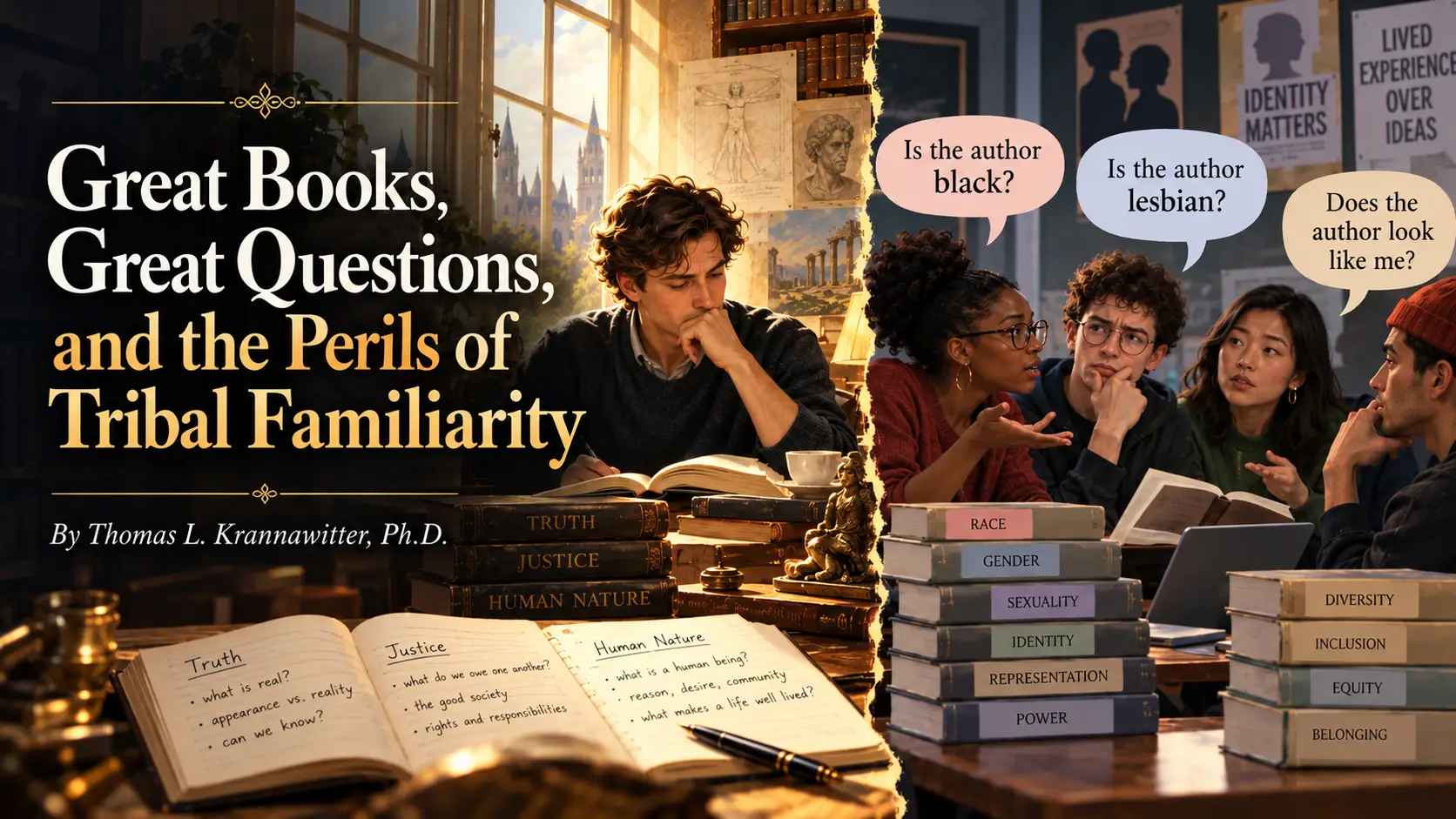
Is the author black? White? Male? Female? Homosexual? Straight? Progressive? Conservative? Has this person experienced the world as I have? Does this person think and feel the way I do?
Such biographical questions can provide useful historical context. But they cannot tell us whether an argument is true.
An intellectually shallow argument does not become profound because its author belongs to a favored demographic group. Nor does an insightful argument become false because its author belongs to an unfashionable one.
Truth has no skin color. Wisdom has no sex. Reason possesses no sexual orientation.
We should study Aristotle because he helps us understand human nature, happiness, and virtue. We should study Frederick Douglass because his extraordinary intellect illuminates liberty, justice, slavery, and the design and purpose of the United States Constitution.
Their experiences matter to understanding their writings. But the merits of those writings cannot be reduced to those experiences. The questions raised by the Greek Socrates about justice matter far more than the fact that Socrates was Greek.
Tribal familiarity replaces the pursuit of truth with the comforting recognition of ourselves. Instead of asking whether an author has discovered something worth knowing, we ask whether the author resembles us. Rather than allowing unfamiliar ideas to challenge our assumptions, we seek reassurance that others share our assumptions.
The result is not classical education. It is intellectual segregation. Lest anyone think I am exaggerating, consider something I experienced recently.
I was invited to conduct an hourlong seminar on the Declaration of Independence for high school history teachers. Our primary text was the Declaration itself, including Jefferson’s rough draft and the edits made by John Adams and Benjamin Franklin. I also included several documents illustrating how Abraham Lincoln invoked the Declaration in his struggle to “place slavery in the course of ultimate extinction.”
Afterward, a female teacher scolded me for my selection of readings. Her complaint? Not one document had been written by a woman.
She lectured me about the importance of selecting literature “representative” of the teachers and students studying it. When I explained that no women participated in drafting the Declaration, she dismissed that historical fact as irrelevant.
Jefferson? Male. Adams? Male. Franklin? Male. Lincoln? Male.
For this teacher, apparently, that was enough to render my reading selections unacceptable—even for a seminar devoted specifically to the Declaration of Independence. Never mind the extraordinary ideas these men articulated. Never mind whether those ideas are true. What mattered was that the men who articulated them were, well, men.
Consider the irony.
The Declaration proclaims self-evident truths about human nature that transcend distinctions of sex, race, and ancestry. Yet here was a teacher more concerned with the sex of its authors than with the truth of its propositions.
She wanted representation. I wanted understanding. And therein lies the difference between tribal familiarity and classical education.
There are many good reasons to study great works written by women. But historical accuracy and intellectual relevance—not the sex of an author—should determine the readings for a seminar devoted to a particular historical document.
Education Beyond Ourselves
One of the greatest gifts of classical education is the opportunity to escape the intellectual limitations imposed by our own time, place, and circumstances.
The Great Books introduce us to people who lived in worlds profoundly different from ours. They challenge beliefs we scarcely realize we hold and compel us to consider arguments we might otherwise never encounter.
Sometimes they reveal that what everyone around us confidently believes is simply wrong.
This does not mean the authors of the Great Books were infallible. Quite the contrary. They disagreed with one another, often about the most important questions imaginable. Their greatness lies partly in the seriousness with which they investigated those questions—and their capacity to help us investigate them for ourselves.
Classical education, properly understood, does not teach students merely to revere ancient authorities. Classical education invites us to enter a conversation about what is true, what is good, what is just, and how human beings ought to live.
It invites us to think.
And genuine thinking requires the willingness to follow reason wherever it leads—even beyond the familiar comforts of our own tribe. The purpose of education is not to insulate us within an echo chamber surrounded by those who seem familiar. It is to help us understand the world as it truly is.