Table of Contents
ToggleTable of Contents
ToggleIn an age of postmodern vulgarity and moral emptiness, Lincoln’s Gettysburg Address expands the soul and reminds us to look up.
By Thomas L. Krannawitter, Ph.D.
Abraham Lincoln’s Gettysburg Address is known worldwide. Even people in distant lands who might know little about the United States are likely familiar with Abraham Lincoln and his Gettysburg Address.
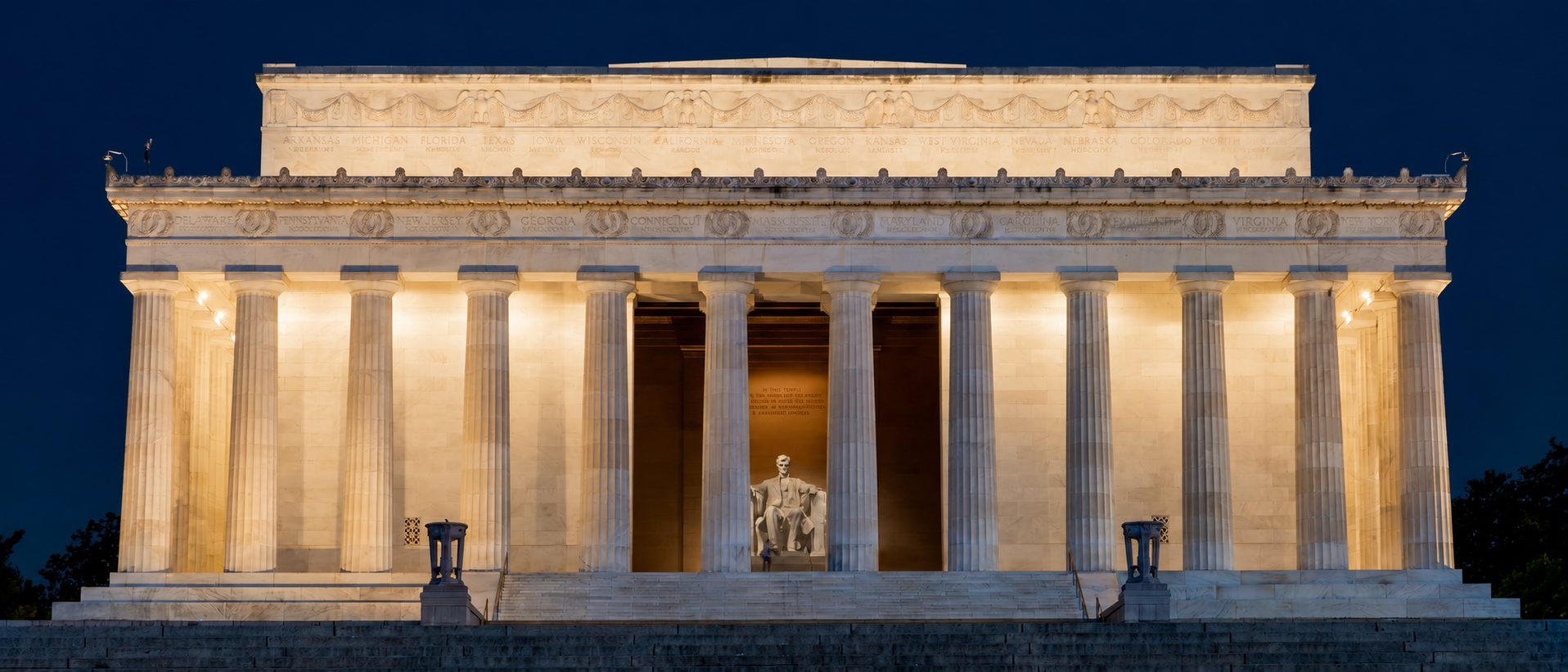
Lincoln’s speech—engraven on the South Wall of the Lincoln Memorial in Washington D.C.—rightly invites comparison with the most famous eulogy of classical antiquity: the funeral oration delivered by the Athenian statesman Pericles in 431 BC for fallen Athenian soldiers, as recorded in Thucydides’ History of the Peloponnesian War.
The speech delivered by the American Abraham, however, surpasses the oration of the famous Greek in almost every way—except length. In just 272 words, Lincoln achieved what no one—Pericles included—had ever done before or has done since.
I humbly suggest that the Gettysburg Address is a work of rhetorical perfection. It cannot be improved or edited in any way.
Context
Lincoln’s brief speech was part of a dedication ceremony at Gettysburg Cemetery on November 19, 1863, following one of the Civil War’s pivotal conflicts.
Several months earlier, from July 1 to July 3, 1863, the Battle of Gettysburg shook the rolling hills and picturesque farmland of southern Pennsylvania, resulting in a Union victory that halted the Confederate invasion of the North. It was one of the bloodiest battles of the war, with over 51,000 soldiers killed, wounded, or missing.
To put this in perspective: more men died in three days at Gettysburg than all the U.S. soldiers killed during the siege of Iwo Jima, which lasted over a month.
In the aftermath of the battle, there was a pressing need to reinter the remains of fallen soldiers, many of whom were placed in hastily dug, shallow graves across the battlefield. The Gettysburg National Cemetery was established to provide a proper burial place for Union soldiers. The dedication ceremony aimed to consecrate the cemetery and honor those who had died in the nearby fields and pastures.
The keynote speaker at the ceremony was Edward Everett, a former governor of Massachusetts, U.S. senator, Harvard University professor and president, and renowned orator. When asked who was the keynote speaker at Gettysburg, virtually no one today knows.
Almost as an afterthought, the organizing committee decided at the last minute to invite President Abraham Lincoln to deliver some “brief remarks” during the ceremony. Those remarks are now remembered worldwide as the Gettysburg Address.
Sometimes less is more.
Ancient and Sacred
The tradition of dedicating cemeteries—the most sacred and holy ground in most cities—dates back to antiquity.
The solemnity surrounding these burial grounds stemmed from the belief, held by most people throughout history, that the gods who protected them, guided them, and occasionally blessed them with victory in war and other gifts, were the spirits of their ancestors—the founding fathers who first established laws for the tribe or clan.
(See The Ancient City by Fustel de Coulanges, originally published in 1864.)
For most ancient peoples, the treatment of the dead was a matter of utmost importance, literally life and death. Burial grounds were sacred because they connected the living with the dead—a bridge between worlds—to be honored, feared, and tread upon with the greatest reverence and respect.
Conception and Birth
The Gettysburg Address is framed by the most profound of all human mysteries—conception and birth, when life itself first whispers into being.
Lincoln opened his speech by describing the United States as a nation “conceived in Liberty.” He closed with a call for “a new birth of freedom.”
Contrasts
Lincoln’s brief remarks at Gettysburg create emotional tension by offering striking contrasts:
- The living versus the dead
- Then versus now
- Speech versus action
- What others did versus what we must now do
- The last full measure of devotion versus the resolve to continue
No Name-Calling
Notably, there are no proper nouns in the Gettysburg Address; no one is identified by name.
Even though a great war was raging as Lincoln spoke, he placed no blame on anyone. He never referred to the South or to the single greatest cause of the war: slavery.
This, after all, was a terrible war between citizens, sometimes between brothers. Instead of assigning blame, Lincoln described the war as a test of whether a nation conceived in liberty and dedicated to the proposition that all men are created equal “can long endure.”
History records that regimes of injustice and slavery—including the cruelest of tyrannies—can last for generations, even centuries. But can a regime of liberty and equal colorless individual rights, endure? Before the American experiment, no one knew. It had never been tried.
Whether we would pass or fail that test at that time would ultimately be determined by all Americans—North and South, black and white, men and women. Whether we can still pass that test, now, will be determined by us.
Ironies abound today as our fellow citizens denounce the United States. The same nation Lincoln described as “conceived in liberty and dedicated to the proposition that all men are created equal,” progressive critics and educators dismiss as the worst nation, ever. Adding confusion atop irony, those same critics and educators often invoke the good and true principles of the American Founding as the reason to denounce the American Founding.
Yet, those critics never pause to ask: If the American experiment in constitutional and personal self-government fell short of the principles of the American Founding, what nation on Planet Earth did not?
What actual regimes, in the annals of human history, are the models of moral and political perfection the rest of the world should emulate? And, even if no nation has lived up to those principles, does that mean the principles are not worth aiming for? Should they no longer serve as the goal?
Understatement
The Gettysburg Address contains perhaps one of the greatest uses of understatement: Lincoln suggested that “the world will little note, nor long remember what we say here, but it can never forget what they did here.”
Today, does anyone other than a few historians remember who was at the Battle of Gettysburg or what they did? No. Yet everyone remembers what Lincoln said there.
Mention the opening line—Four score and seven years ago—and most people instantly recognize it. At Gettysburg, word eclipsed action. The pen proved mightier than the sword.
Dedication
The key movement of Lincoln’s speech shifts the focus from the dead to the living. Although the ceremony’s purpose was to dedicate a battlefield cemetery, Lincoln redefines “dedication” to focus on the living:
It is for us the living, rather, to be dedicated here to the unfinished work which they who fought here have thus far so nobly advanced.
In a decisive respect, the living are more important than the dead—even as we honor the deeds and sacrifices of those who have fallen.
The work of the dead is done. The hardest work lies ahead—for the living. It is the living who need fortification, inspiration, and focused dedication. The dead may deserve praise and respect, but they have little need for it.
Lincoln subtly, almost esoterically, redefines the term “dedication” from something we do to honor a new building, church, or structure—like a ceremony formally recognizing and consecrating a newly-built cemetery—into something deeply personal and internal: dedication as resolve to finish the work at hand.
Let’s Date
The memorable dating in the opening line of the Gettysburg Address is key to understanding the entire speech.
When Lincoln, in November 1863, referred to “four score and seven years ago”—eighty-seven years ago—he was referencing 1776.
What was significant about 1776? The Declaration of Independence was approved on July 4, 1776—Independence Day. The Declaration of Independence was the foundation upon which Lincoln built his Gettysburg Address.
The ideas enshrined in the Declaration of Independence—that all human beings are equally human by the human nature they all share; that natural human equality is the source of important, universal moral and political principles; that every individual possesses an unalienable, natural right to life, liberty, property, and the free pursuit of happiness; and that the only legitimate purpose of government is to protect these unalienable natural rights—formed the core of Lincoln’s moral and political views.
These same ideas formed the core of the original Republican Party platform, on which Lincoln was elected President in 1860.
In November 1863, it was “four score and seven years ago” that the Founding Fathers “brought forth on this continent, a new nation, conceived in Liberty, and dedicated to the proposition that all men are created equal.”
We are uniquely blessed that they did, for no one else in all prior history had ever founded a nation upon such noble ideas and the true principles of natural justice. We should be appreciative, grateful, thankful—and more. We should show our gratitude by being “dedicated here to the unfinished work which they who fought here have thus far so nobly advanced.”
Hallowed Ground
While the Founders established this nation “conceived in Liberty, and dedicated to the proposition that all men are created equal,” the work of maintaining and sustaining it belongs to subsequent generations. It belongs to us.
Those who fought and died at the Battle of Gettysburg “gave the last full measure of devotion.” Honoring them is the purpose of the cemetery’s dedication ceremony:
Now we are engaged in a great civil war, testing whether that nation, or any nation so conceived and so dedicated, can long endure. We are met on a great battlefield of that war. We have come to dedicate a portion of that field as a final resting place for those who here gave their lives that that nation might live. It is altogether fitting and proper that we should do this.
Yet Lincoln is quick to add:
But, in a larger sense, we cannot dedicate—we cannot consecrate—we cannot hallow—this ground. The brave men, living and dead, who struggled here have consecrated it far above our poor power to add or detract.
We cannot make the bloodied ground hallowed; it was hallowed by the “brave men” who “struggled here.” What we can do, however, is continue the fight and finish the work.
It is rather for us to be here dedicated to the great task remaining before us—that from these honored dead we take increased devotion to that cause for which they gave the last full measure of devotion—that we here highly resolve that these dead shall not have died in vain—that this nation, under God, shall have a new birth of freedom—and that government of the people, by the people, for the people, shall not perish from the earth.
Open Your Mind
Read the Gettysburg Address. Then re-read it. Reflect. Study. Think. Meditate. Discuss the Gettysburg Address with people who are thoughtful, serious, and intellectually able. Let Lincoln’s “brief remarks” transport your thinking to that which is ancient, timeless, profound, and the source of everything we consider good. Look up and let the transcendent be the standard by which we judge the timely; measure that which changes by that which does not. Being is more important than becoming.
As a Lincoln scholar, I am often asked how long it took Lincoln to write the Gettysburg Address. Myths persist that he wrote the speech on a napkin, from scratch and within a few minutes, while riding in a carriage to Gettysburg. That is nonsense.
The real answer is that it took Lincoln thirty years to be able to write the Gettysburg Address. He invested time, energy, and attention studying the core ideas of liberty—enshrined forever in the Declaration of Independence—the philosophical pedigrees of those ideas, and the serious critiques of them.
Lincoln practiced communicating those ideas repeatedly, in both speech and writing. He gave long speeches and short ones. He wrote lengthy letters and essays, and brief ones. He listened to those who agreed with him and he studied carefully the arguments of those who did not.
He never stopped deepening his own understanding and honing his rhetorical skills, ultimately preparing himself to articulate the meaning of the Civil War and the challenges of self-governance—in the context of the natural right principles of the American Founding—in 272 beautiful, true, and unforgettable words.
Spend some time unraveling the many rhetorical, philosophical, and poetic nuances of Lincoln’s Gettysburg Address. The effort will repay you many times over. And be grateful that you, my friends and fellow citizens, were fortunate enough either to be born in or to have immigrated to this United States of America—far from perfect, yet still “the last best hope of Earth,” in the words of Abraham Lincoln.




Contact Us