Table of Contents
ToggleTable of Contents
ToggleEducation for Virtue, Self-Government, and Happiness.
By Thomas L. Krannawitter, Ph.D.
Young people should be taught that they must learn and practice how to be good before they can be happy, rather than being told merely to “be themselves.”
The modern phrase “be yourself” is not altogether wrong. A mature human being should not live as a fraud, a coward, or a mere imitation of others. But the phrase becomes dangerous when addressed to the young as though the self they presently possess is already whole, already authoritative, already worthy of affirmation in all its desires and impulses.
Children are not born self-governing. They are born with powers, passions, and potentials that require formation. They must learn what to love, what to fear, what to admire, what to reject, how to speak, how to reason, how to restrain themselves, and how to act when pleasure, anger, or fashion pulls them in the wrong direction.
A good education does not tell the young merely to express themselves. It teaches them how to become selves worthy of expression.
Virtue
The grand purpose of education for children should be the development of moral and intellectual virtue—which is merely an old word for excellence—and, to an extent, physical virtue, too, because all the virtues are intrinsically connected to one another.
Just as running fast, throwing accurately, and seeing clearly are physical virtues, so too choosing justice and exercising courage are moral virtues, while thinking well, avoiding logical errors, and looking for accuracy to the degrees various subjects admit of accuracy are intellectual virtues.
Education for children should begin with the basic tools of thinking and speaking, such as grammar, logic, and what used to be called rhetoric.
More abstract thinking, such as mathematics, physics, and chemistry, should follow, as well as the art that most beautifully connects the realm of numbers with the motions of the soul: music.
These forms of early education should be framed by stories that encourage young minds to love what is good and noble, and to be repulsed by that which is morally repulsive. Children should explore stories that spark the moral imagination.
It does not matter whether Mordor is a real place or whether Sauron is a real being. The lesson is that sometimes good people must take a stand against terrifying armies of injustice, even if victory can only be deserved, not guaranteed.
Good fiction should be an important part of a good education that prepares children to live as mature, just, self-governing adults.
Students should see models of what courage, justice, moderation, and wisdom look like, and what they require. They should understand how each virtue is contained within the others. Aristotle pointed out long ago, for example, that a person frozen with fear or wild with panic is unlikely to think or choose well. Wisdom requires courage.
Sound education for young people is based upon the premise that choices and actions are inseparable from human life. Part of learning is understanding that by nature healthy hands should be able to grab and hold objects; arms should be able to lift and throw; legs should be able to run and jump.
These skills require practice. They are activities that become greater sources of pleasure for those who perfect them. Students should be encouraged to be physically active and healthy.
The same is true of the moral and intellectual virtues. It is unrealistic to expect a young person who has engaged only in injustice and deceit to become just and honest instantly.
A person who does not know what it means to think well because he has never practiced thinking—because he has never committed logical errors in the presence of a patient teacher who points out the errors and helps the student reason better—is unlikely to think well when others want or need him to think well.
This is why happiness must be understood properly. Happiness does not mean a passing feeling, a mood, a burst of pleasure, or the absence of frustration. It does not mean that every desire has been affirmed or every appetite satisfied. Happiness, rightly understood, means the flourishing activity of a well-ordered soul. It is the condition of a human being whose powers are ordered toward what is good, true, beautiful, and noble.
That kind of happiness cannot be handed to a child through slogans. It must be learned, practiced, and earned.
Seeing the World by Looking Up
Young students should be introduced to the idea of looking at the world vertically—up and down, hierarchically—because the world is hierarchical, both in nature and in the world of human conventions.
Within nature, all living beings are important. Each has its own place. Still, there are hierarchies. There is a food chain, for example. Some animals are apex predators; others are not. Even within herd animals, one finds social hierarchies.
So, too, among human conventions, there are hierarchies. Each art serves its own purpose and, at the same time, produces a product or condition that is used for higher purposes.
The art of saddle-making, for example, produces saddles that are beautiful and useful to horsemen. The art of horsemanship produces riders who may serve as cavalry. The art of generalship organizes cavalry and other forces for victory in war. The art of statesmanship determines what victory is for.
There is a hierarchy among these ends. Beautiful saddles are pleasing to the eye and comfortable for riders. But the saddle exists for the sake of riding. Riding sometimes serves the purposes of military action. Military action serves the purposes of victory. And victory itself raises the higher political question: What should we do with our victory?
Should we continue to make war merely for the sake of war? We can always find new enemies, if needed. Or does war, too, point to something higher than itself?
War is in the service of peace. We fight wars not because we love war, but because we love the peace that victory in war may produce.
Studying the Good and Practicing How to Live Well
And even peace is not the highest good. Once peace is won, we still can and should ask: What should we do with our peace?
How should we live?
How should we live together, socially and politically, as fellow citizens and potential friends?
How should I, as an individual human being, live?
What is the right or best way of life? What is the way of life most fitting for a being that is both physical and metaphysical, both body and mind?
The answer is that peace provides the opportunity to govern ourselves, to live freely and well, and to strive for physical, moral, and intellectual excellence. The combination of these excellences is necessary for human happiness, fully and philosophically understood.
This is why education is never merely private. A republic depends upon citizens who can govern themselves. No constitution, however well designed, can compensate indefinitely for souls habituated to appetite, resentment, envy, cowardice, or fashionable opinion.
Free government assumes a certain kind of human being: one capable of listening, judging, restraining himself, honoring what is higher, and acting for goods beyond immediate gratification.
The classroom, therefore, is one of the first workshops of republican liberty. Long before students vote, hold office, serve on juries, raise families, or lead institutions, they are learning whether their own desires should rule them, or whether reason, conscience, and virtue should rule their desires.
Peace provides the opportunity to exercise all the virtues toward which a good education aims. This is why education matters. This is why the right kind of education matters more.
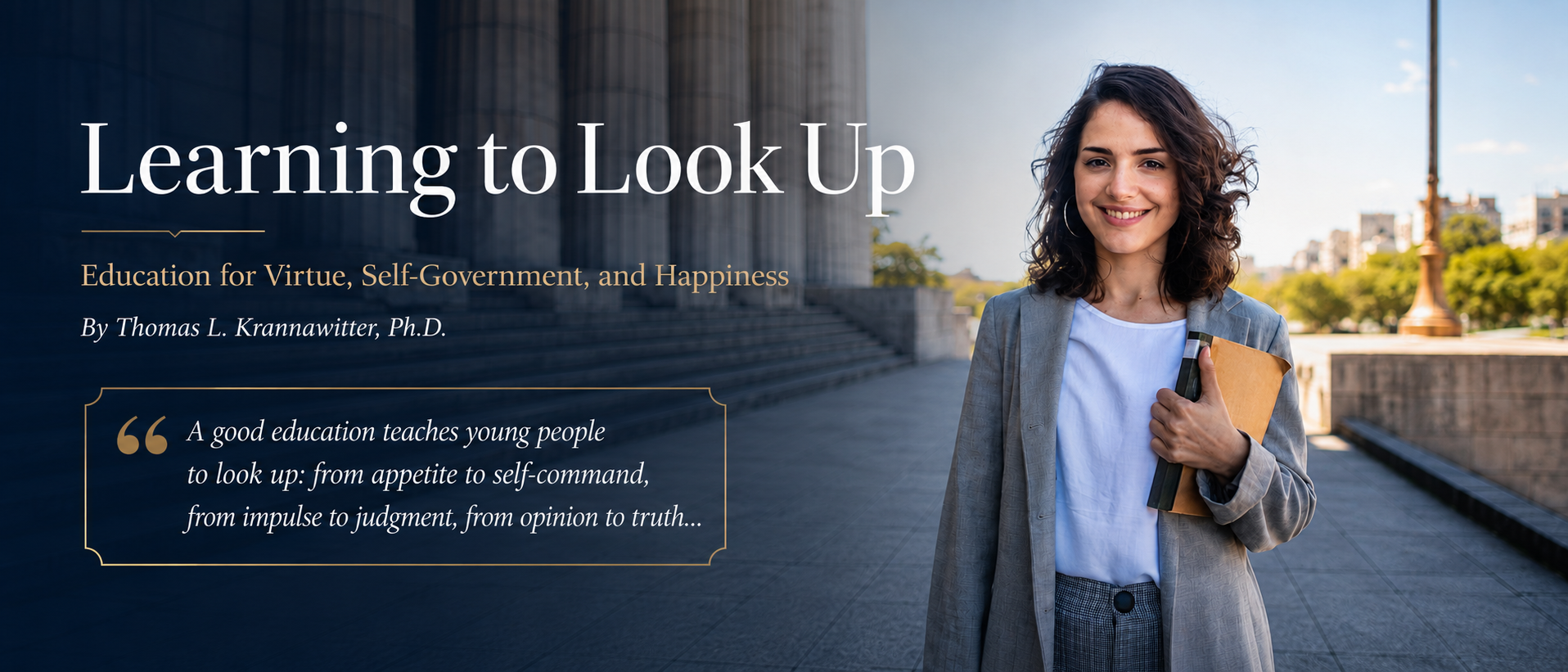
A good education teaches young people to look up: from appetite to self-command, from impulse to judgment, from opinion to truth, from pleasure to happiness, from power to justice, and from mere self-expression to the disciplined liberty of a self-governing soul.




Contact Us