Not Every Difference of Opinion Is a Difference of Principle


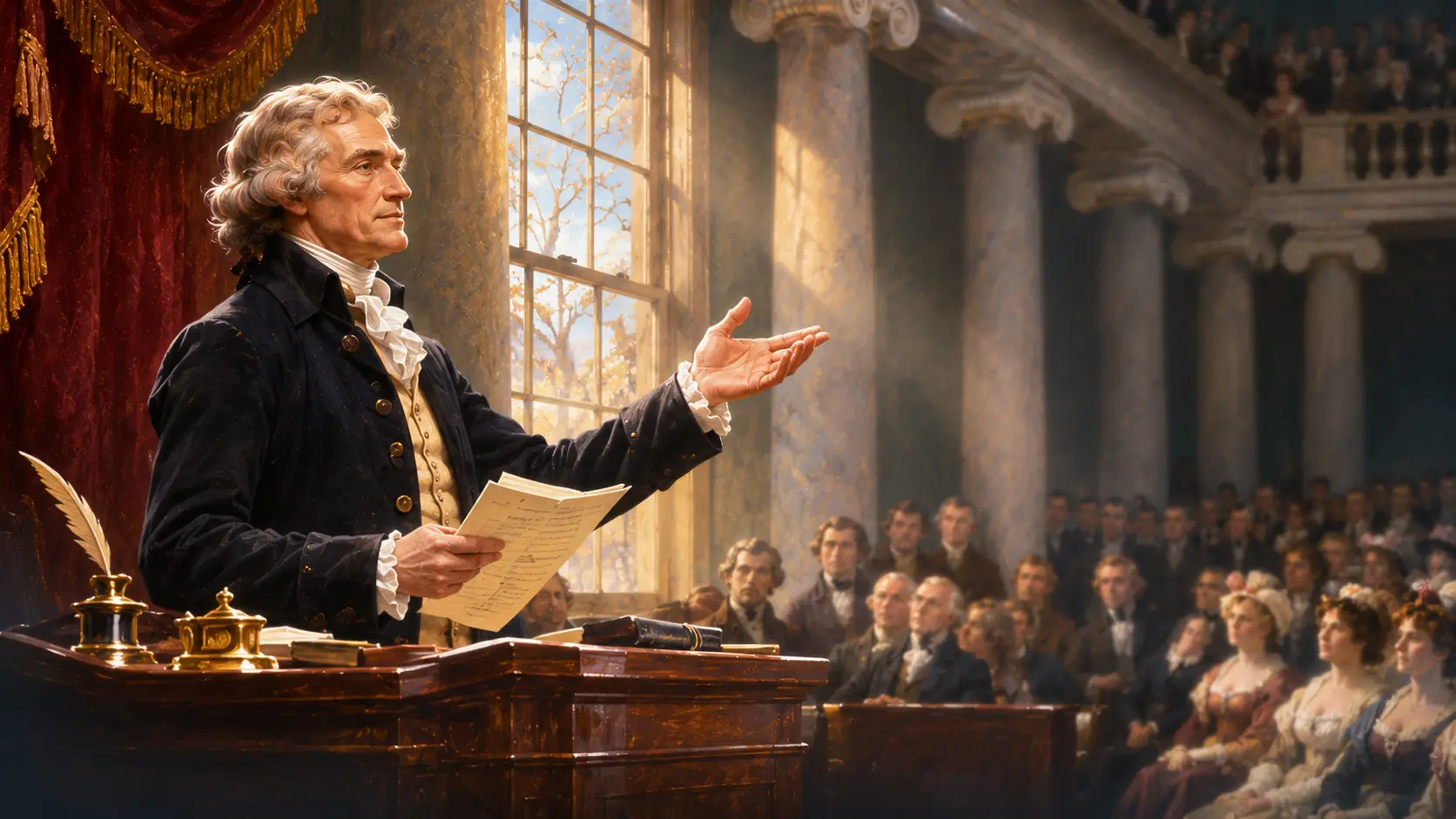

Thomas Jefferson, political division, and the principles that unite—or divide—a free people
Americans awoke this morning to the aftermath of another contentious election. Some are celebrating. Others are dismayed. Many are undoubtedly wondering what the results mean for the future of our country.
These occasions inevitably produce calls for national unity. We are urged to put aside our differences, respect one another, and remember that we are all Americans. Such sentiments are understandable, even admirable. But they raise a question that is rarely examined carefully: What precisely might unite us?
Is it enough that we are all United States citizens? That we live under the same Constitution? That we accept the results of elections, even when our preferred candidates lose?
I suggest that Americans must share something more fundamental: a common understanding of the principles of justice upon which our nation and political institutions were established. For help thinking about these questions, let us turn to a remarkable speech delivered more than two centuries ago.
Among the carefully selected primary sources in the Waypoints Library is Thomas Jefferson’s First Inaugural Address, delivered on March 4, 1801. I included this speech because Jefferson does something far more interesting than merely appeal for political civility. He invites his fellow citizens to think about the principles that might unite them—that should unite them—the disagreements that might divide them, and the responsibilities of people who claim the right to govern themselves.
The occasion was extraordinary.
The presidential election of 1800 was among the most bitter in American history. Jefferson’s Republicans and John Adams’s Federalists regarded one another with profound suspicion. Partisan hostilities threatened the stability of the young republic. It was a genuine question whether the losing side would accept the results of a constitutional election.
The election produced a tie in the Electoral College between Jefferson and his running mate, Aaron Burr. Under the original constitutional arrangement, the election moved to the House of Representatives, where the Federalists still held considerable power.
The House voted repeatedly. Only on the thirty-sixth ballot, on February 17, 1801, was Jefferson finally elected president.
Alexander Hamilton, who had little affection for Jefferson, nevertheless encouraged Federalists to support him rather than Burr, whom Hamilton considered less trustworthy and more dangerous.
It was against this backdrop of bitter partisan contention and constitutional uncertainty that Jefferson delivered his inaugural address.
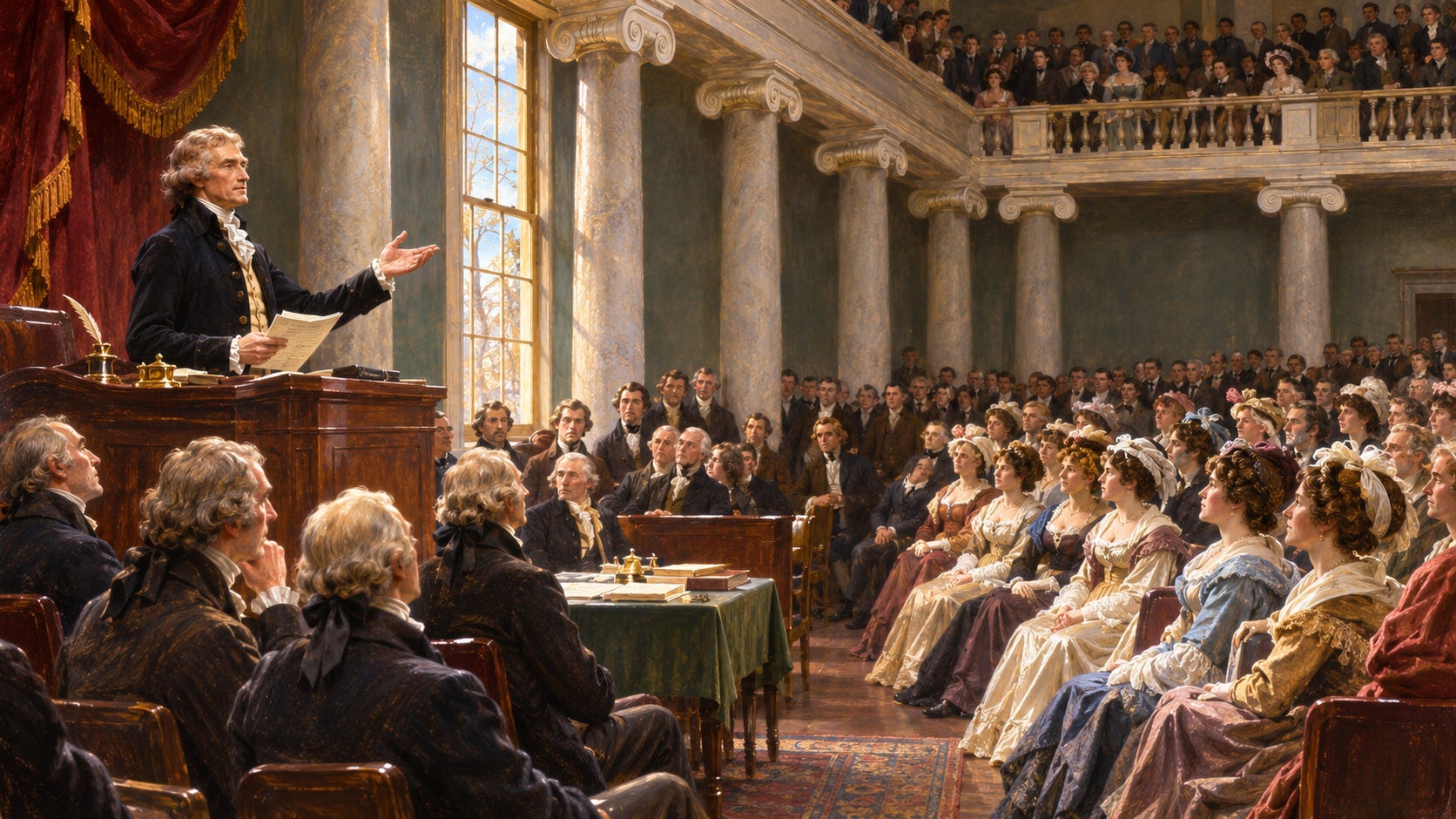
He had every opportunity to celebrate his victory, denounce his opponents, and insist that the people had vindicated his political principles. But he did not do that. Instead, Jefferson offered an argument about the meaning of republican self-government.
While Jefferson’s First Inaugural Address is not long—and I encourage you to read it for yourself—here I will focus on the second paragraph, which has many principles packed into few words.
Jefferson begins by acknowledging that the election has been decided according to the Constitution and that citizens should now unite in common efforts for the common good. But he immediately adds a qualification of immense importance:
Though the will of the majority is in all cases to prevail, that will to be rightful must be reasonable; that the minority possess their equal rights, which equal law must protect, and to violate would be oppression.
Winning an election confers the authority to exercise the powers of a political office within the limits of the Constitution. It does not confer the moral authority to violate the rights of those who supported the losing side.
A majority might vote to tax and confiscate the property of an unpopular minority. It might vote to suppress political dissent, prohibit religious practices, or deny equal protection of the laws to people who hold unpopular opinions.
Would these measures become just merely because a majority approved them? Jefferson’s answer is no.
He distinguishes between the political power to prevail and the moral right to exercise that power. The latter must be governed by reason and respect for the equal rights of others.
Notice, too, that Jefferson does not suggest that minorities possess rights because majorities have graciously granted them. Those in the minority already possesses equal rights—natural and unalienable individual rights. The obligation of government is to protect them.
This is a profoundly important distinction, especially in an age when democracy is often treated as though it were synonymous with justice. A government may be democratic and nevertheless act tyrannically. The mere fact that political power is exercised with the approval of a voting majority does not establish that its exercise is just.
But Jefferson was not merely reminding Americans of the limitations of majority rule. He was also asking them to reconsider the nature of their disagreements.
After lamenting the political intolerance that had poisoned public life, Jefferson offered this observation: “But every difference of opinion is not a difference of principle.”
It is a short sentence, easily overlooked. Yet it invites an extraordinary amount of reflection.
Notice Jefferson’s careful wording. He did not say that no differences of opinion are differences of principle. Some are. He said not every difference of opinion is a difference of principle. The distinction is important.
Consider two citizens who agree that government exists to secure the natural rights of individuals but disagree about whether a particular law or policy will accomplish that purpose. One believes the proposed law will protect liberty; the other believes it will undermine or constrain liberty.
Their disagreement might be serious. Both might passionately defend their positions. Yet they share a common principle—government should protect the liberty of individual citizens—by which their opposing judgments can be examined. Their disagreement concerns the best means of securing an end upon which they agree.
Now consider a different disagreement.
One citizen believes that all human beings possess equal natural rights, that these rights are not gifts granted by government, and that government’s proper purpose is to secure them.
Another rejects natural rights altogether. He believes that individual rights are merely permissions granted by government and that the purposes of government are whatever those possessing political power decide them to be.
These citizens do not merely disagree about which policies might best secure individual rights. They disagree about what rights are, whether human beings possess them by nature, and the proper purposes of government itself. This is a difference of principle regarding ends, not merely a difference of opinion about political means.
The Declaration of Independence is especially helpful here.
The Declaration announces that all human beings are created equal, possessing certain unalienable rights by nature, and that governments are instituted to secure these rights, deriving their just powers from the consent of the governed.
It further declares that when government becomes destructive of these ends, the people possess the right to alter or abolish that government and establish a new one more likely to secure their safety and happiness.
These were not merely eighteenth-century policy preferences. They were claims about human nature, moral equality, legitimate political authority, and justice. They supplied the moral justification for American independence and helped establish the principles by which American government could be judged.
Which raises a difficult question for Americans today: Do we still agree about these principles?
We may disagree about tax rates, education, immigration, economic regulations, or innumerable other matters while sharing a common understanding of the proper purposes of government. But what if some Americans reject the self-evident moral-political truths of the Declaration?
What if our political disagreements concern not merely the means of securing liberty and justice, but the very meaning (or existence) of liberty and justice? In that case, appeals for national unity may conceal rather than resolve the fundamental disagreements dividing us.
Jefferson followed his distinction between opinion and principle with one of the most memorable declarations in American political history: “We have called by different names brethren of the same principle. We are all Republicans, we are all Federalists.”
Imagine how strange these words must have sounded to Americans who had spent months denouncing one another as Republicans and Federalists. Jefferson was not suggesting that political parties did not matter. Nor was he pretending that their disagreements were insignificant.
Rather, he was directing attention toward something more fundamental than partisan affiliation.
Americans are republicans insofar as they embrace government deriving its authority from the people rather than from rulers claiming an independent right to govern. They are federalists insofar as they remain faithful to the constitutional Union. And the principles of the Declaration supply a more fundamental standard by which the justice of their government can be judged.
These commitments do not eliminate disagreements about the proper distribution and exercise of political power. But they offer a common foundation upon which citizens might reason together about those disagreements. Jefferson invites Americans to consider whether the principles they profess to share are more important than the political labels that divide them.
And that invitation remains useful today. Before asking whether someone is a Republican or a Democrat, a conservative or a progressive, perhaps we ought to ask more fundamental questions.
What does that person believe about human nature? About natural rights? About the proper purposes of government? About the relationship between individual liberty and political power?
These questions might reveal that people belonging to different political parties share important principles. They might also reveal that people belonging to the same party disagree about matters of fundamental importance.
Political labels cannot substitute for philosophical understanding. Yet there is a difficulty that Jefferson himself recognized. What should we do about those who reject the very principles upon which our political community rests?
Jefferson anticipated this question in the very next sentence:
If there be any among us who would wish to dissolve this Union or to change its republican form, let them stand undisturbed as monuments of the safety with which error of opinion may be tolerated where reason is left free to combat it.
This is a remarkable defense of political liberty. Jefferson was not merely urging Americans to tolerate minor disagreements about public policy. He was willing to tolerate people who wished to dissolve the Union or replace republican government with another form of political rule.
Why?
Because he distinguished between tolerating persons and accepting their political principles as true. He did not suggest that all political opinions are equally sound or that moral and political judgments are merely arbitrary “values.” Rather, Jefferson was confident that a free and virtuous people could confront genuine political errors through reasoned argument rather than persecution and censorship.
Still, Jefferson’s argument presents a profound challenge.
Can we recognize those who reject the fundamental political principles of our regime as fellow citizens, entitled to the same protection of their rights as everyone else?
I believe the principles of the Declaration require us to answer yes. If human beings possess natural rights by virtue of being human, those rights do not disappear when people embrace mistaken or even dangerous political ideas.
The rights of free speech, freedom of conscience, and the peaceful expression of political opinion cannot be reserved exclusively for people who agree with us. To make them conditional upon ideological agreement would contradict the very principles we claim to defend.
This does not mean that all political opinions are equally true, equally reasonable, or equally compatible with justice. It means that we must distinguish between defending the truth of our political principles and coercively suppressing those who dispute them.
There is no contradiction in recognizing someone as a fellow citizen while believing that person’s understanding of justice is profoundly mistaken. Indeed, the distinction may be indispensable to free government.
But another question remains.
Even if a republic can tolerate fundamental disagreements among its citizens, can it endure indefinitely without substantial agreement about the principles that justify its existence? History offers reasons for taking this question seriously.
The United States itself was founded upon a declaration of human equality and natural rights while tolerating the institution of slavery, a glaring contradiction between its principles and its practices. Jefferson himself participated in that contradiction.
Eventually, Americans would confront a fundamental disagreement: Should the practice of slavery be abolished in order to honor the principles of the Declaration? Or should those principles be abandoned or reinterpreted in order to accommodate the practice? That disagreement could not be resolved by pretending that the parties merely differed over prudential details.
Lincoln would later insist that the principles of the Declaration were indispensable to understanding the American republic. The Civil War would test whether a nation founded upon those principles could survive when its citizens became fundamentally divided over their meaning and application.
Perhaps, then, we should distinguish unity from uniformity.
Uniformity suggests that people think alike, agree about important questions, or arrive at the same conclusions. A free republic neither requires nor should desire uniformity.
But genuine political unity requires something more substantial than merely living within the same national borders or submitting to the same government. It requires a common political life sustained by shared institutions, mutual obligations, and sufficient agreement about justice to permit citizens to resolve their disagreements without treating one another as enemies.
This brings us back to a particularly moving sentence in Jefferson’s address: “Let us restore to social intercourse that harmony and affection without which liberty and even life itself are but dreary things.”
Jefferson recognized that political disagreements can become so bitter that they destroy the friendships, affection, and mutual regard that enrich ordinary human life. He wanted Americans to recover those things, but he did not propose that they accomplish this by abandoning reason, refusing to judge competing principles, or pretending that truth and error are indistinguishable.
Quite the contrary.
His confidence in republican self-government rested upon a confidence in the capacity of ordinary human beings to reason about political matters. He ended this extraordinary paragraph by asking:
Sometimes it is said that man cannot be trusted with the government of himself. Can he, then, be trusted with the government of others? Or have we found angels in the forms of kings to govern him? Let history answer this question.
Here, finally, is the question underlying the entire argument. Can human beings govern themselves?
Not merely by voting, but by exercising the intellectual and moral judgment necessary to distinguish rightful government from oppression, sound arguments from unsound ones, and political differences that concern prudence from those that concern fundamental principles.
If we believe the answer is yes, then we must take seriously the education of citizens in the principles of liberty and justice. And we must preserve the freedom necessary for citizens to examine those principles, question them, argue about them, and arrive at judgments of their own.
Jefferson was not asking Americans to abandon their convictions in the name of unity. He was asking them to remember what was worth defending, to recognize what they might share, and to reason together about what divided them.
That seems a worthy undertaking in the aftermath of any election. And it leaves us with a question more important than which political party prevailed yesterday:
Do Americans still share the fundamental principles that make us one people, capable of governing ourselves in liberty?
And if we do not, what becomes of our elections?
Elections can determine who will govern. They cannot, by themselves, determine what constitutes rightful government. They cannot transform injustice into justice merely by counting votes. Nor can they confer upon political majorities a rightful authority to violate the natural rights of minorities.
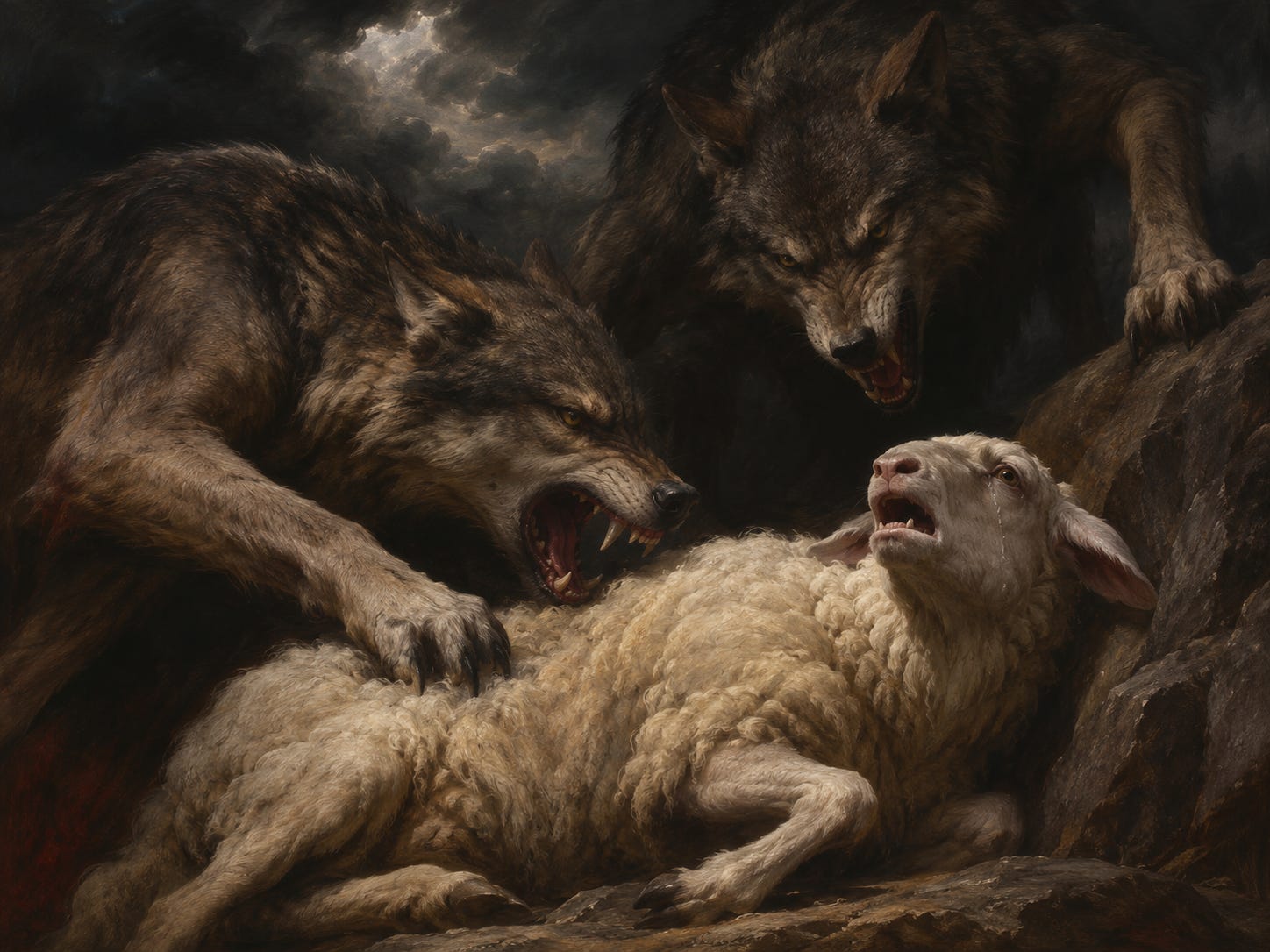
Imagine two wolves and a sheep voting on what to have for dinner. The problem is not that the three hold an election. The problem is that two of them believe winning the election entitles them to devour the third.
Jefferson understood the distinction. If we wish to remain united as a free people, we must understand it, too.

She wanted representation. I wanted understanding. And therein lies the difference between tribal familiarity and classical education.
The Therapist and the Influencer in an Age That Forgot the Good Life
At Waypoints, we provide civic education resources that feature primary sources for high school teachers.