The Great Conversation

The Therapist and the Influencer in an Age That Forgot the Good Life
- admin123

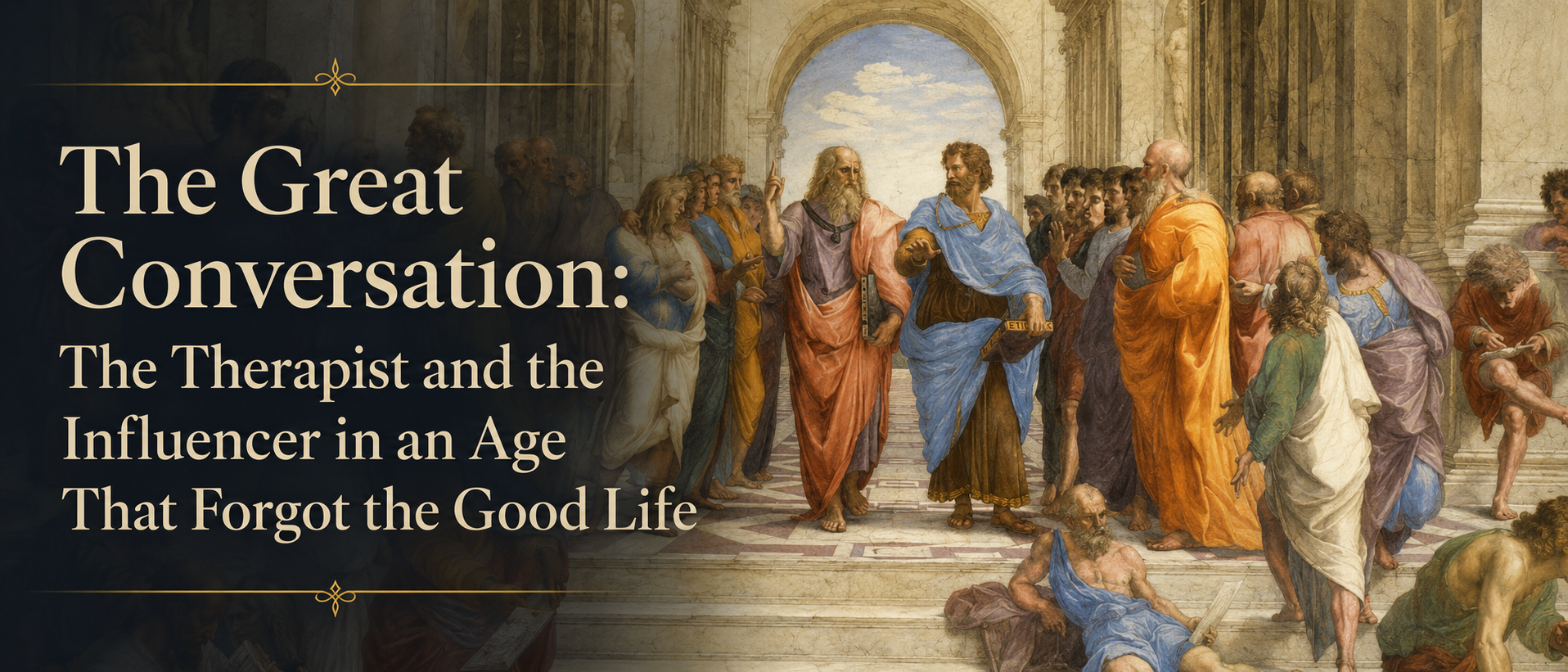

The Therapist and the Influencer in an Age That Forgot the Good Life
How should I live my life?
The question is simple enough for a child to understand and profound enough to occupy the greatest minds. It is more fundamental than the question of how to become wealthy, famous, powerful, comfortable, admired, or secure. Those are questions about means and circumstances. This is a question about ends. It asks what kind of person one should become, what objects are worthy of love, which desires should be governed, what obligations should be honored, what pains should be endured, what should be protected, what one should try to achieve, and what is required to live well.
It asks: What purpose should my life serve?
Every civilization answers this question, directly or indirectly. A regime provides its answer through laws, institutions, heroes, customs, stories, songs, rituals, rewards, punishments, and silences. Parents answer it when they praise or correct their children. Teachers answer it through what they elevate and what they ignore. Politicians answer it when they explain what citizens should sacrifice in order to preserve. Religious communities answer it when they distinguish the sacred from the profane. Even those who insist that no answer exists reveal an answer through the lives they commend.
For more than two thousand years, Western civilization was animated by an extraordinary argument about the best way for human beings to live. That argument was not always peaceful. At times it was bitter, coercive, even bloody. Yet at its best it generated a sustained and deeply thoughtful encounter between two of the most formidable claims ever made upon the human soul.
One arose from Athens: the claim of reason.
The other arose from Jerusalem: the claim of revelation.
Athens asked what the human mind—using unassisted reason—can discover about nature, justice, virtue, happiness, the good, and the highest things human beings can comprehend. Jerusalem proclaimed that the Creator had spoken, that human beings stood under divine law, and that the path to righteousness required obedience, humility, faith, repentance, and love.
The alternatives, however, were never as simple as reason without piety or faith without reason. Plato treated piety as a serious philosophical question. For Aristotle, philosophy culminated in contemplation of the highest things, including the divine. Augustine reasoned relentlessly about revelation. Aquinas built one of the most intricate intellectual structures in history to show how faith and reason could be distinguished without being separated. Jewish, Christian, and Islamic thinkers all wrestled with the relation between philosophy and revealed law.
Nevertheless, the tension was real. What is the good life? Is it the life of unyielding philosophic inquiry, in which no proposition or authoritative opinion is protected from examination? Or is it the life of faithful obedience to the one living God? Does the highest human excellence consist in loving and knowing the truth, or in loving and obeying God? Is reason the surest path toward truth, or must reason itself be guided and corrected by revelation? The vitality of Western civilization arose from its refusal to abandon either side of that conversation.
Athens would not permit revelation to silence every question. Jerusalem would not permit reason to present itself as sovereign over all things. Philosophy challenged complacent faith. Revelation challenged the pride of philosophy. Each exposed the characteristic danger of the other. Reason could become arrogant, bloody, and tyrannical. Faith could become fanatical, unexamined, or oppressive.
Their profound disagreement proved intellectually fruitful because neither could conclusively refute the other. That tension tended to moderate the claims of both, reducing the danger that reason would harden into science-based tyranny or that revelation would descend into religious persecution.
Yet because both traditions affirmed that truth existed and that human life could be ordered toward it, their argument remained an argument about something real.
Athens and Jerusalem disagreed over the answer. Both rejected the notion that there was no answer. Both were confident that an answer exists and both pursued the answer, only in different ways.
“The Great Conversation” is often used to describe the centuries-long exchange among the most thoughtful writers, statesmen, poets, theologians, scientists, and philosophers of the Western tradition. The participants did not merely repeat one another. They argued across generations, sometimes across millennia.
The conversation changed, but the permanent questions remained.
What is justice? What is human nature? Are there natural rights? Is virtue necessary for freedom? Can law make citizens good? What is the relation between reason and revelation? What do we owe one another? What is the purpose of political life? What distinguishes liberty from license? What goals are worth suffering or sacrificing to achieve? Is happiness a feeling, an activity, a condition of the soul, a gift of grace, or some combination of these?
Western civilization did not flourish because it reached final agreement on these questions. It flourished because it took these questions seriously and debated them rigorously—often heatedly.
The argument generated habits of mind as well as conclusions. It taught intellectual humility: one entered a discussion already populated by minds greater than one’s own. It taught courage: inherited opinions can be questioned. It taught discipline: claims require reasons. It taught reverence: some questions point to higher concerns than personal appetite and convenience. It taught moderation: political life always involves goods in tension. It taught responsibility: the soul can be cultivated or it can be corrupted.
The civilization that emerged from Athens and Jerusalem established universities, monasteries, constitutional forms, scientific institutions, churches, courts, legislatures, printing presses, libraries, and schools. Those institutions were imperfect because human beings are imperfect. They frequently betrayed their own principles. Yet they preserved the possibility that ordinary persons can enter an ongoing conversation about permanent things while engaging with great minds.
Political communities, families, churches, schools, and local associations transmitted these understandings imperfectly but persistently. Parents corrected children. Teachers cultivated habits. Clergy distinguished temptation from duty. Elders drew upon experience. Philosophers asked what is true. Statesmen deliberated about justice and the common good.
The ordinary person did not need to read Plato or Aquinas to inherit concepts shaped by them. Ideas descend into public life through institutions, language, law, education, and custom. John Maynard Keynes observed that practical men who consider themselves free of intellectual influence are often governed by the ideas of some defunct economist or “academic scribbler.”1 His point extends well beyond economics.
Millions of Americans have never read Rousseau, Nietzsche, Heidegger, Foucault, Derrida, or other postmodern thinkers. Yet they have absorbed postmodern assumptions that descend, however indirectly and often crudely, from intellectual revolutions those thinkers helped advance.
Public opinion is rarely self-created. It is usually the diluted, simplified, moralized, and politicized residue of arguments most citizens have never studied. For that reason, as we turn to postmodernism, I will distinguish postmodern philosophy from what I call postmodern popular opinion.
Literally, “postmodern” is what comes after “modern.” In the history of philosophic and scientific thought, the movement initiated by Machiavelli and continued by Bacon, Descartes, Hobbes, and Locke, was modernity, in contrast to classical antiquity.
What came after modernity—featuring thinkers such as Rousseau, Nietzsche, and Heidegger—is postmodernity. And ours today is a very postmodern world.
Postmodern philosophy is not a single doctrine. It includes thinkers who differ sharply from one another, and it cannot be reduced to a slogan about relativism. Serious scholars rightly resist casual descriptions that place every critic of modern rationalism into one undifferentiated category.
Postmodern popular opinion is something else.
It consists of assumptions held by people who likely have never opened a work of philosophy. The defining premise of postmodern popular opinion is that there are no objective, unchanging, transcultural truths concerning morality, justice, virtue, human excellence, meaning, purpose, or the good life. There are only subjective perspectives, personal feelings, contingent conventions, and arbitrary cultural constructions—none right, none wrong, and none that can be used as a standard to judge the others.
What one society calls noble, another calls oppressive. What one generation calls shameful, another celebrates. Every moral standard is said to reflect a particular time, place, class, race, sex, religion, or structure of power. Because no perspective can rise above its own conditions, no way of life can be known to be better in itself than another. There are merely differences—hence the postmodern celebration of “diversity.”
The striking feature of this premise is how often it is asserted dogmatically—yet without inquiry, investigation, or knowledge.
The person who says no moral truth exists makes a universal claim about moral truth. The person who declares that no one may judge the choices of others because there is no objective standard by which to judge, usually proceeds to judge dissenters swiftly and severely. The culture that insists all values are relative remains absolutely certain that rejection of its favored values is intolerably wrong.
These contradictions rarely disturb those who repeat them. Postmodern popular opinion is seldom the product of sustained philosophical reflection. More often, it is the accumulated inheritance of a culture whose assumptions are accepted long before they are examined—if they are examined at all.
“Do not judge.”
“Live your truth.”
“Be authentic.”
“Follow your feelings.”
“Celebrate diversity.”
“No one may tell another person how to live.”
Each slogan contains a fragment of truth. Human beings should judge cautiously. Individual circumstances differ. Hypocrisy is real. Coercion can be cruel. Customs sometimes masquerade as nature. Majorities can persecute minorities. Traditions can preserve injustice.
But a fragment of truth becomes false when inflated into a complete account of moral life. A defining feature of our postmodern world is that we live largely by fragments and slogans.
One cannot condemn unjust judgment without distinguishing justice from injustice. One cannot praise authenticity without asking whether all authentic desires are good. One cannot celebrate every difference, because some differences involve cruelty, degradation, or vice. One should not advise human beings simply to follow their feelings when feelings are unstable, contradictory, and frequently self-destructive.
Postmodern popular opinion teaches people to distrust every inherited standard except the command to distrust inherited standards. It announces that there is no objective way to distinguish a noble life from a degraded one, then condemns as immoral and degraded anyone who refuses to celebrate its latest approved lifestyle.
It tells us not to judge while judging constantly and harshly.
Most important, it leaves people with a burden no civilization can remove. Every human being wants happiness. Every human being wants life to have meaning. Every human being wants to know that some choices are worth making, some sacrifices worth enduring, and some excellences worth transforming into habits.
Postmodern popular opinion tells us that these goods are nothing but cultural illusions, and then invites us to pick some—just not the “wrong” ones.
The Great Conversation did not end when modern or postmodern philosophy arose.
Machiavelli, Bacon, Descartes, Hobbes, Locke, and their successors altered the terms of the debate profoundly. Modernity lowered or redirected some classical aims. It placed new emphasis upon self-preservation, rights, consent, material improvement, mastery of nature, and relief of suffering. It challenged inherited authorities and often weakened the public credibility of revelation.
Yet the major modern thinkers did not generally abandon the idea of objective truth. They claimed to have discovered firmer foundations for it.
Bacon did not say all forms of knowledge were equally valid. He proposed a method for overcoming observational errors. Descartes doubted in order to arrive at certainty. Hobbes did not deny that political order could be understood rationally; he offered a systematic account of it. Locke defended natural rights as truths grounded in human nature, not as preferences peculiar to certain classes of seventeenth-century Englishmen. The authors of the Declaration of Independence called certain truths self-evident, not prejudices, perspectives, or values. Lincoln insisted that the principles of the Declaration supplied a moral standard by which the nation—and any other nation—should judge itself.
Modernity altered the answers but preserved the questions.
Even the modern pursuit of progress depended upon standards. To say that one condition is an improvement over another presupposes a judgment about what is better—and the very concept of better requires an idea of the good. Health is better than disease. Peace is better than war. Knowledge is better than ignorance. Liberty is better than arbitrary rule. Prosperity is better than poverty.
The postmodern turn is more radical.
It does not merely propose a new answer to the question “How should I live?” It increasingly denies that there is any good life to discover—only a smorgasbord of lifestyles from which to choose.
That change sounds liberating. It promises freedom from judgment, inherited duty, oppressive convention, theological restraint, and philosophical hierarchy. It tells each person that he may create his own meaning, define his own identity, and insist that others affirm both.
But human beings do not create meaning as easily as they create usernames.
A person may choose among occupations, neighborhoods, hairstyles, diets, entertainment, political affiliations, and consumer products. He cannot simply decide that cowardice is courage, betrayal is fidelity, foolishness is wisdom, or loneliness is friendship. Reality resists arbitrary preference. Actions produce consequences. Character forms through repetition. The soul can become ordered or disordered regardless of what vocabulary a culture adopts.
The disappearance of the vocabulary of the good life therefore does not eliminate moral longing. It makes that longing inarticulate.
People continue to hunger for guidance but become suspicious of teachers. They seek moral authority while denying that anyone possesses authoritative knowledge. They want meaning but reject standards that might distinguish meaningful from meaningless. They desire community while defining freedom as liberation from obligation. They want affirmation without judgment, identity without nature, self-esteem without achievement, and happiness without discipline.
The results are not freedom and serenity. They are often confusion, anxiety, resentment, loneliness, fragility, fear, and dependence.
Classical philosophy began by investigating nature: what each kind of thing is, especially human nature. It recognized that nature does not dictate one biography for everyone, but supplies standards by which human beings can know something about how to live well.
Because human beings are rational, social, political, and embodied, certain activities fulfill them better than others. Courage, justice, moderation, prudence, friendship, and contemplation are not arbitrary preferences. They are excellences of a particular kind of being—just as running fast is an excellence of horses.
Biblical religion offered a different but related moral structure. human beings are created, fallen, obligated, judged, and loved. Duties are real. Sin is real. Grace, repentance, forgiveness, and redemption are real. Suffering can have meaning because life has a purpose beyond immediate pleasure.
Both traditions understood moral education as the formation of the soul.
The passions were not simply to be suppressed, nor were they automatically to be obeyed. They were to be educated, shaped, and directed, all with a view to the good. Desire can learn to take pleasure in noble ambitions. Anger can serve justice. Fear can protect life. Love can improve oneself and others. Shame can steer a person toward better choices in the future.
A free person is not someone who has no internal restraints and lives “untamed.” A free person is someone capable of governing himself.
Postmodern popular opinion treats such language with suspicion. It associates moral judgment with oppression and inherited standards with prejudice. When no way of life may be judged better than any other, every lifestyle becomes a version of “the good life.” This postmodern message often appears as a rhetorical question: “Who is to say what the good life is?” And those who ask such a question typically assume no answer is possible.
When virtue cannot be defined objectively, the language of character gives way to the language of preference. When the passions cannot be educated according to reason or revelation, they must be expressed, affirmed, or acknowledged.
The greatest human question is reduced to an empty instruction: Live however you feel like living.
But feelings cannot tell us whether they deserve obedience. A man may feel envy, cruelty, lust, cowardice, self-pity, or rage. A woman may feel affection for a person who abuses her or contempt for a person who loves her. A citizen may feel hatred toward political opponents because he has been trained to misunderstand them. A child may feel injured by every correction.
The mere existence of a feeling establishes a fact about the person who feels. It does not establish a fact about the justice, wisdom, or goodness of acting upon it.
The classical task was to educate the passions. The postmodern task is to validate them. That transformation helps explain the extraordinary expansion of therapeutic authority.
Talk therapy can be of great help to some people in some circumstances.
There are individuals who witness horrors ordinary people can barely imagine. Others endure violence, abuse, cruelty, betrayal, catastrophic loss, or prolonged fear. Some suffer mental illnesses that impair perception, judgment, emotional regulation, sleep, and the ability to function. Competent treatment may help such people recover their bearings, regain agency, and resume their lives.
No thoughtful person should mock therapy or dismiss it categorically. Like many people, I have personally benefited from wise therapeutic counsel, and I remain grateful for it.
Yet it is equally difficult to deny that the language, assumptions, and institutions of therapy have expanded far beyond the treatment of grave mental illness or extraordinary trauma. We inhabit something resembling a therapeutic state: a society in which increasing portions of ordinary life are translated into psychological categories and addressed through professional intervention.
The term therapeutic state can suggest government administration, but the phenomenon is much broader than government. It encompasses schools, universities, workplaces, medical institutions, popular entertainment, political rhetoric, social media, and family life. Emotional well-being becomes a public concern. Ordinary disappointments acquire diagnostic vocabulary. Institutions promise safety not only from violence but also from discomfort, offense, contradiction, and disagreement.
The numerical growth of the therapy profession during the past century is remarkable.
Because the United States has no single national registry for all practitioners who conduct talk therapy, exact totals are difficult to determine. Licenses are issued by states and divided among clinical social workers, professional counselors, marriage and family therapists, clinical and counseling psychologists, and related professions. A reasonable contemporary estimate places the total somewhere between 650,000 and 750,000 licensed therapists.2
That amounts to approximately 200 therapists for every 100,000 Americans.
Historical comparisons are necessarily approximate because most modern licensing categories did not yet exist. Nevertheless, the broad historical trend is unmistakable.
Around 1940, psychotherapy was conducted chiefly by psychiatrists, psychoanalysts, a comparatively small number of psychologists, and psychiatric social workers. The best historical estimates suggest there were only about 10 therapists for every 100,000 Americans. Remarkably, this was during the Great Depression and the Second World War—a period of extraordinary psychological strain.
By 1960, the field had expanded through veterans’ programs, clinical psychology, psychiatric social work, and community mental health. The number of therapists had risen to approximately 25 to 30 per 100,000 Americans.
By the 1980s, new counseling professions were emerging and state licensing systems were spreading across the country. The number had climbed to roughly 100 therapists per 100,000 Americans.
By 2000, the profession had expanded into the hundreds of thousands, amounting to roughly 150 therapists for every 100,000 Americans.
Today, the figure stands at approximately 200 therapists for every 100,000 Americans.
The comparison is revealing.
Between 1940 and today, the population of the United States increased by roughly two and a half times—from approximately 132 million to about 340 million people.
During that same period, however, the number of therapists appears to have increased roughly seventyfold, depending upon how one defines the profession. America has not merely added therapists because it added people. It has become a vastly more therapist-intensive society.
Population growth alone cannot explain this transformation.
Part of the explanation is straightforward and benign. Americans are more willing to seek assistance. Stigma has declined. Treatments have improved. Insurance and public programs now cover services that were unavailable to earlier generations. The nation has developed professional capacities that scarcely existed a century ago.
But those explanations are incomplete.
Demand has expanded not merely because more Americans suffer severe mental disorders. Therapy increasingly addresses the ordinary fears, pains, disappointments, conflicts, uncertainties, and transitions that are inseparable from human life.
The mental health profession itself acknowledges this distinction.
The Diagnostic and Statistical Manual of Mental Disorders is devoted principally to diagnosing mental disorders. Rather than relying on secondhand descriptions, I turned to the DSM-5 itself. There, beginning on page 715, is a section titled “Other Conditions That May Be a Focus of Clinical Attention.”3
The title is revealing.
The conditions listed there may properly become the subject of professional attention even though they are not themselves mental disorders. They include relationship distress, parent-child conflict, bereavement, educational and occupational difficulties, housing and economic problems, acculturation difficulties, religious or spiritual problems, and other circumstances of personal and social life.
The distinction is sensible. Losing a spouse is painful, but grief is not a disease. Marital conflict may be devastating, but disagreement between husband and wife is not automatically a psychiatric disorder. A crisis of faith may unsettle an entire life, but spiritual doubt is not by itself mental illness. Unemployment, loneliness, disappointment, failure, and family disruption can cause real suffering without constituting dysfunction in the medical sense.
The DSM-5 also cautions that expectable responses to common stressors and losses are not automatically mental disorders. Nor is conflict between an individual and society sufficient by itself to establish one.
This distinction sharpens the cultural question.
If increasing numbers of Americans seek professional mental-health assistance for conditions that are not mental disorders, what work are therapists now being asked to perform?
The answer, I believe, is that therapy has expanded into territory once occupied by moral instruction, family counsel, friendship, religious teachings, philosophy, and the wisdom of experienced elders.
This does not mean therapists conspired to seize that territory. Most respond to clients who arrive voluntarily. Many are conscientious, humane, and aware of the limits of their discipline. The deeper question concerns the culture that supplies those clients.
In short, why has therapy come to occupy territory once held by philosophy, religion, family, and friendship? A civilization uncertain about the good life still produces persons who must live. It therefore needs and even demands substitutes for the forms of guidance it has discredited.
Consider the ordinary experiences of adulthood.
A person fails and feels humiliated. He grieves after a death. He is anxious before a difficult decision. He discovers that marriage requires sacrifice. He struggles to discipline his appetites, control anger, remain faithful, raise children, forgive injuries, accept aging, or find meaningful work.
These are not trivial matters. They can be painful, frightening, and morally demanding.
Earlier generations often understood them as problems of living requiring virtue, counsel, duty, faith, friendship, endurance, repentance, prudence, or time.
Our culture increasingly redescribes them in therapeutic language.
One hears constantly of trauma, triggers, boundaries, validation, self-care, emotional safety, toxic relationships, healing journeys, lived experience, and personal truth. Some of these expressions identify genuine phenomena and can be used intelligently. Taken together, however, they often encourage a view of life in which discomfort is pathology, disagreement is harm, criticism is violence, suffering is evidence of injustice, and affirmation is the highest form of care.
Got a promotion—or failed to receive one? Talk to a therapist.
Cannot find a date—or have begun dating? Talk to a therapist.
Disagree with your spouse? Talk to a therapist.
Struggling to focus? Talk to a therapist.
Distressed by someone’s political hat, medical mask, pronouns, bumper sticker, or flag? Talk to a therapist.
The examples can be exaggerated. The tendency cannot.
Ordinary difficulties are increasingly treated as occasions for professional interpretation and intervention.
That tendency corresponds closely to postmodern popular opinion. If no objective answer exists to the question “How should I live?,” the therapist cannot confidently direct a client toward a rationally defensible conception of human excellence. He may help identify preferences, reduce distress, establish goals, regulate emotions, or improve function. Those may be useful accomplishments.
But toward what end?
Mental health cannot be understood without some conception of human flourishing. To say a mind is healthy is to imply that it functions well. To say it functions well is to imply a standard of what the mind is for, of the good at which the activities of the mind aim. Yet mental health professionals are ill-equipped to answer the question: “Does human life have purpose?”
The therapeutic state’s expansion therefore raises additional questions: Is the healthy person merely one who feels comfortable? One who achieves self-selected goals? One who adapts successfully to his environment?
What if his goals are vicious, immoral, or criminal? What if his environment is corrupt? What if comfort requires self-deception? What if adaptation means learning to thrive within injustice?
Clinical practice cannot escape moral questions by refusing to name them. It can only conceal the moral answers it has already assumed.
The fact that therapists are educated within postmodern institutions does not make every therapist a postmodernist. Some reject moral or cultural relativism. Some may even draw upon older moral and religious traditions and understand that good treatment sometimes requires confronting rather than validating a client. Some recognize that courage may require acting despite fear, that maturity requires accepting responsibility, and that freedom requires self-command.
Still, the governing culture of therapy often hesitates to speak of objective human goods. It is more comfortable helping clients clarify what they want than asking whether what they want is honorable or worthy.
“Right now I feel __________” has become one of the few propositions treated as incontestably true.
The feeling may be transient, contradictory, self-destructive, or based upon false perception. Yet it is mine, and therefore authentic. In a culture uncertain of moral facts, subjective feeling becomes a substitute for objective truth.
This creates a paradox.
A society that rejects authoritative judgments about the good life produces people desperate for guidance. Yet the professionals to whom they turn are often trained not to provide the moral judgment those people most need.
Where else, then, do postmodern Americans look? They look toward a screen.
When ancient fables described a sage living on a distant mountaintop, the distance mattered. The mountain mattered. Wise counsel demanded effort. The seeker had to climb.
The influencers of today require no climb. They are instantly and continuously available. One needs only a screen and an internet connection.
We used to speak of sages, philosophers, theologians, statesmen, teachers, and wise elders. The terms now sound strange to our postmodern ears—too elevated, judgmental, formal, or hierarchical.
“Influencer,” however, rolls easily off the tongue.
The modern influencer is not merely a person who influences others. Parents, poets, pastors, professors, generals, demagogues, actors, and friends have always exercised influence.
A social-media influencer is a person who acquires authority through digitally mediated attention, apparent (not actual) intimacy, and measurable audience engagement, and who can convert that authority into commercial, cultural, or political action.
The influencer’s principal asset is attention.
An influencer’s standing is measured through followers, views, likes, shares, engagement rates, conversions, subscriptions, and sales. The influencer acquires attention, maintains it, and converts it into money, access, status, or political leverage.
The scale is enormous. Roughly one in five American adults now reports obtaining news regularly from social-media influencers. Among adults under thirty, the proportion is double that. American spending on creator advertising reached approximately $37 billion in 2025.4
Influencers are no longer marginal curiosities. They have become major sources of information, taste, aspiration, political opinion, and personal guidance.
What is not required to become an influencer? Wisdom. Intelligence. Truth. Virtue. Responsibility. Accomplishment.
An influencer may possess all of those things. Some are excellent teachers, journalists, artists, scholars, physicians, or critics who use new media well. The category does not tell us a person is bad.
It tells us almost nothing about his excellence. It tells us that he commands attention.
Traditional authority was often distant but publicly intelligible.
A judge held an office. A professor possessed learning. A minister served a religious tradition. A statesman bore political responsibility. An elder had lived long enough to watch choices ripen into consequences.
The influencer may possess none of these foundations. Instead, he possesses familiarity.
Followers watch him in his car, kitchen, bedroom, gym, or living room. They observe meals, frustrations, purchases, opinions, vacations, romances, illnesses, and private emotions. He speaks casually into a camera. He appears spontaneous, candid, approachable, and real.
The follower begins to feel that he knows the influencer. The influencer does not know the follower.
This is parasocial intimacy: a one-sided relationship experienced as personal familiarity. It creates a powerful kind of trust. The influencer feels less remote than an institution, less formal than an expert, less demanding than a teacher, and less judgmental than an elder.
Here again, postmodern popular opinion does its work.
Traditional authority asked a person to recognize someone above himself in knowledge, office, experience, or virtue. Influencer culture promises something at once flattering and flattening. The authority figure is just like you. He is not above you. He is not better than you. And you are not expected to become better than you already are. He is your friend. He validates your instincts. He shares your grievances. He confirms that your enemies are contemptible and your preferences authentic.
The new authority is not higher. It is closer. But closeness is not wisdom.
The classical sage would ask us to become better. The postmodern influencer reassures the individual that he need not change much—that he should simply “be himself.”
Traditional celebrities were ordinarily famous for something: acting, music, athletic achievement, military command, public office, invention, scholarship, inherited rank, or some notable accomplishment.
Many influencers are famous primarily for maintaining attention. Their defining achievement is the production and management of visibility. People know who they are because people know who they are.
That distinguishes the influencer from the classical persons to whom human beings once turned for guidance.
“Influencer,” by contrast, is a functional category. It describes what someone can cause others to notice, buy, imitate, believe, discuss, or do. The title says nothing about whether the influence is good.
A sage may influence people, but influence follows from wisdom. For the influencer, influence itself is the defining achievement.
The sage is listened to because he is thought wise. The influencer is often thought wise because he is listened to.
The philosopher seeks to know. The influencer seeks to be noticed.
The philosopher examines premises, distinguishes appearance from reality, and follows arguments toward conclusions that may be unpopular or personally inconvenient. The influencer operates within platforms rewarding speed, confidence, emotional force, novelty, and continuous production.
The philosopher may say, “I do not know.” The influencer must post again tomorrow.
Philosophy slows judgment. Social media accelerates it.
Philosophy teaches that popularity is not evidence of truth. The influencer’s environment quantifies popularity and displays it beside every utterance.
A philosopher may also become an influencer. Yet insofar as he submits his thinking to constant engagement, the roles pull in opposite directions.
The genuine theologian directs attention beyond himself. His subject is God, sin, duty, salvation, and the order of creation. Whatever personal authority he possesses should remain subordinate to the sacred things he serves. The influencer builds a personal brand.
Even religious influencers face a structural temptation. The message becomes inseparable from the messenger, and the messenger gradually becomes the principal object of attention. A religious teacher may use social media without surrendering to influencer culture. But when followers become devotees of personality rather than students of truth, ministry yields to celebrity.
The wise elder inhabits a real community. He knows those who seek his counsel. He remembers their parents, recognizes their weaknesses, understands their duties, and may live with the consequences of his advice. His authority accumulates slowly through experience and judgment. The influencer’s authority can arise overnight.
The elder may know twenty people deeply. The influencer may be recognized by twenty million people while knowing almost none of them.
The elder’s authority is embodied, local, relational, and accountable. The influencer’s authority is scalable, mediated, performative, and often weakly accountable.
The contrast with statesmanship is especially revealing. The statesman bears responsibility for the common good of a political community. He deliberates about law, war, taxation, justice, security, institutions, and future generations. His choices affect people who did not choose to support him, as well as those who did. His test is not whether an audience remains entertained. It is whether his judgment preserves or improves the regime. The statesman must sometimes tell citizens what they do not want to hear. He may accept temporary unpopularity for long-term public good.
The influencer depends upon voluntary attention. Followers can disappear with one touch. He must remain continuously attractive.
The statesman must govern passions. The influencer often prospers by exciting or inflaming them.
The statesman must reconcile competing goods and interests within a whole community. The influencer can select a niche, intensify its grievances, and ignore everyone outside it.
A statesman has constituents. An influencer has followers. A constituent remains a citizen when he disagrees. A follower can unfollow.
Statesmanship must accommodate disagreement in ways influencer culture does not.
The therapist and the influencer have become two of the principal authorities in postmodern America because both begin with the self.
The therapist asks, “How do you feel?” The influencer says, “Watch how I feel.”
Neither must remain trapped there. A good therapist may lead a patient beyond immediate feeling toward reality, responsibility, discipline, courage, and healthier relationships. A serious influencer may direct followers toward learning, excellence, faith, or civic duty.
But the cultural forms begin with subjective experience. The therapist helps the self interpret itself. The influencer performs the self for others.
One offers affirmation in private. The other displays affirmation in public.
One monetizes professional attention by the hour. The other monetizes popular attention by the click.
Both flourish where traditional authorities have lost credibility and objective standards are treated with suspicion.
This does not mean therapist and influencer are morally equivalent. It means they often answer parallel needs created by the same moral vacuum. Human beings still need counsel. They still need models. They still want someone to tell them their lives make sense or serve a purpose higher than themselves.
Postmodern popular opinion denies that anyone can know the good life objectively. Therapy therefore turns inward toward emotional authenticity. Influencer culture turns outward toward visible popularity.
Feeling and attention become substitutes for truth and excellence. The great irony is that a culture devoted to autonomy produces extraordinary dependence. People liberated from every inherited standard become dependent upon professionals to interpret their emotions and upon digital personalities to model identities for them.
They are told to think for themselves, yet increasingly outsource judgment.
They are told to live authentically, yet their desires are shaped by algorithms, advertisers, therapeutic vocabularies, and manufactured personas.
They are told no one may define the good life for them, then spend hours watching strangers demonstrate what to wear, eat, buy, believe, fear, admire, and become.
Autonomy without standards does not produce self-government. It produces individuals vulnerable to manipulation.
The therapeutic state and influencer culture are therefore not accidental companions. They are parallel expressions of a civilization that has lost confidence in moral knowledge while retaining an undiminished hunger for moral guidance.
The rejection of objective standards does not produce neutrality. If truth, justice, virtue, and the good are merely cultural constructions, what remains after postmodern culture has jettisoned the goods toward which human beings once aimed?
Power remains.
Appetite remains.
Popularity remains.
Technique remains.
The person who commands attention wins. The person who feels most intensely claims authority. The person who can manipulate the algorithm appears important. The person who can classify another as unhealthy, unsafe, hateful, or disordered gains moral leverage without having to defend a substantive account of human flourishing.
Few labels discredit a person today more quickly than “hater,” and the charge requires no explanation of what love means or why it is good.
A society suspicious of moral judgment does not cease judging. It merely changes the vocabulary of judgment.
Sin becomes pathology. Vice becomes dysfunction. Disagreement becomes harm. Heresy becomes misinformation. Cowardice becomes anxiety. Self-absorption becomes self-care. Resentment becomes authenticity. Political opposition becomes threat.
Some of these translations may occasionally illuminate. Often they obscure.
Therapeutic language can become moral language pretending not to be moral. It condemns while denying that it condemns. It directs conduct while claiming only to promote well-being. It establishes hierarchies of healthy and unhealthy, safe and unsafe, affirming and harmful, without explaining the conception of the human good by which those terms acquire meaning.
Influencer culture performs a similar feat. It establishes hierarchy while pretending to abolish hierarchy. Everyone may speak, but only a few command attention. Everyone may express an opinion, but algorithms and platforms determine which opinions become visible. The old gatekeepers are replaced by new ones whose judgments are less transparent and more intimately tied to profit.
The democratization of speech coexists with the concentration of attention. Everyone can now publish. Almost no one is seen.
Those who are seen acquire authority through numbers displayed publicly beside their names. Followers, likes, and views become visible signs of rank. A culture that professes equality creates a numerical aristocracy of attention.
This hierarchy is especially powerful because it masquerades as popular choice. The follower feels autonomous. He selected the account, clicked the video, liked the post, and purchased the product. Yet every choice occurs within an environment designed to capture attention, predict behavior, intensify emotion, and extend engagement.
A person becomes a user. A user becomes a product. The product imagines itself free.
The answer is not to abolish therapy, abandon technology, silence influencers, or return romantically to an imagined past.
The old authorities were not always wise. Families could be cruel. Clergy could abuse power. Teachers could be ignorant. Statesmen could be corrupt. Philosophers could be vain. Elders could transmit prejudice as easily as prudence.
The Great Conversation itself teaches us to question authority. But it also teaches that criticism requires standards.
The abuse of authority does not prove that authority is unnecessary. False judgment does not prove judgment impossible. Hypocritical morality does not prove that moral truth is unreal. Bad philosophy does not discredit philosophy as a way of life. Corrupt religion does not settle the question of revelation. Foolish elders do not abolish the need for wisdom. Demagogues do not eliminate the need for statesmanship.
The proper response to bad authority is better authority. The proper response to false judgment is sound judgment. The proper response to manipulation is education in freedom. That recovery begins by restoring distinctions.
Not every discomfort is harm. Not every desire deserves affirmation. Not every disagreement is oppression. Not every intense feeling reveals truth. Not every popular person possesses wisdom. Not every credential establishes judgment. Not every tradition is just; nor is every tradition unjust. Not every innovation is progress. Not every lifestyle is equally conducive to human flourishing.
A free society requires citizens capable of making these distinctions. Self-government is impossible without self-command. Political liberty cannot survive indefinitely among persons who understand freedom only as release from every restraint.
The recovery of judgment also requires a more serious understanding of therapy.
The best therapy need not validate every desire. It can help people encounter reality. It can strengthen agency, responsibility, courage, honesty, fidelity, patience, and self-command. It can help a person distinguish pain that signals injury from pain that accompanies growth. It can remind clients that grief is not failure, fear is not always danger, and discomfort is not necessarily pathology.
Therapy becomes most humane when it recognizes that psychological health is not merely comfort but a capacity to live in truth and accept what is real.
Influence can also be redeemed.
A person with an audience may use attention to direct others toward worthy objects. He may recommend serious books, explain difficult ideas, display craftsmanship, cultivate gratitude, expose corruption, inspire courage, encourage justice, or strengthen civic friendship.
The question is not whether influence exists. It always will. The question is what deserves influence.
The important question is not whether therapists help people. Many do. Nor is it whether influencers influence. Plainly they do.
The important question is: By what standard should therapy and influence themselves be judged?
A therapy that makes a person more comfortable in vice is not healthy merely because it reduces distress. An influence that produces engagement is not admirable merely because millions respond.
The classical answer is that authority must be subordinated to truth, justice, wisdom, virtue, and civic friendship.
Therapy should help restore persons to reality, responsibility, self-command, friendship, meaningful work, and genuine flourishing.
Influence should direct attention toward things worthy of attention.
But postmodern popular opinion treats such standards as mere cultural illusions. Attention therefore becomes evidence of importance. Popularity becomes evidence of authority. Engagement becomes evidence of insight. Emotional intensity becomes evidence of truth.
The Great Conversation offers a different discipline.
Athens asks: Is the claim true? Is the argument sound? What is the nature of the thing? What kind of soul does this activity cultivate? Does it contribute to happiness properly understood? Does it encourage people to look up?
Jerusalem asks: Is it faithful? Is it righteous? Does it honor God and neighbor? Does it encourage humility, repentance, love, and obedience to what is higher than the self? Does it encourage people to look up?
The questions do not always yield identical answers. Yet both refuse to let desire validate itself. Both summon the human being beyond immediate appetite. Both insist that the soul can be educated. Both deny that popularity is proof of goodness.
That is why the Great Conversation remains indispensable.
It preserves the possibility of judgment without pretending judgment is easy. It gives us rival accounts of the good life without surrendering to the claim that the good life is a myth. It allows reason and revelation to challenge one another while resisting the nihilism that dismisses both.
The Great Conversation has not ended. Plato is still asking whether justice is good in itself. Aristotle is still asking what activities constitute human flourishing. The prophets are still demanding justice and pious obedience. The Gospels are still commanding love of God and neighbor.
Augustine is still distinguishing restless desire from the peace found in the highest good. Aquinas is still asking what reason can know and where revelation must guide it. Shakespeare is still showing ambition, jealousy, love, folly, and self-deception more clearly than most clinical manuals. Locke is still arguing about natural rights, liberty, education, and toleration. Jefferson is still appealing to self-evident truths. Lincoln is still asking whether a nation dedicated to equality can endure.
They are all waiting.
No algorithm is required to enter the conversation. No credential is necessary to begin. One needs only a willingness to read, listen, question, and submit one’s own opinions to examination.
The recovery of the Great Conversation does not require universal agreement. It requires the restoration of moral and intellectual seriousness. It requires parents willing to say that some habits are better than others. Teachers willing to distinguish knowledge from opinion. Clergy willing to speak of sin, duty, mercy, and truth rather than reducing religion to emotional reassurance. Political leaders willing to speak of the common good rather than merely mobilizing grievances. Therapists willing to distinguish affirmation from health. Public figures willing to use influence in service of excellence rather than treating attention as the highest good.
Most of all, it requires individuals willing to ask the question our age tries to forget: How should I live?
The question is not oppressive. It is liberating because it assumes human life is intelligible, that choices matter, that excellence is possible, and that we are capable of learning.
What happens when the influencer’s path leads nowhere—when purchases, affirmations, identities, outrage, followers, and views fail to provide meaning? What happens when a person discovers that being told every feeling is valid does not teach him which feelings should govern his life? What happens when autonomy becomes loneliness, self-expression becomes performance, and liberation from every standard becomes an inability to judge anything at all?
The answer cannot be merely another session of affirmation or another person to follow. The tragedy is not that modern Americans suffer. Every generation suffers.
The tragedy is that increasing numbers have forgotten where to seek wisdom about suffering and other fundamental human experiences.
Having assumed—without inquiry or investigation—that truth, virtue, and the good life are illusions, they search endlessly for relief from the emptiness that assumption creates.
They do not need only someone to listen. They do not need only someone to watch. They need reasons to live well, and explanations about how.
Raphael’s famous painting, School of Athens, offers a remarkable visual symbol of the Great Conversation. The two central figures are, fittingly, Plato and Aristotle.
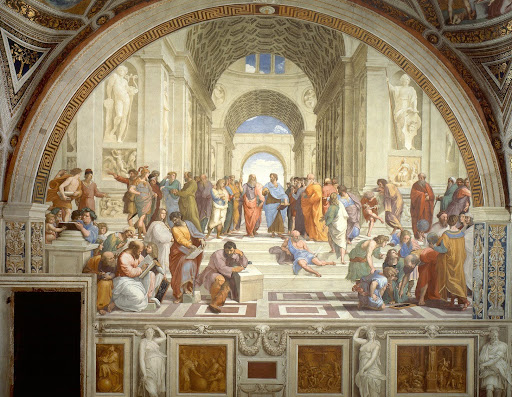
Plato points upward toward the eternal and transcendent. Aristotle gestures toward the world of nature and human experience. They disagree about where the search for truth and wisdom should begin.
Yet one feature of the painting is especially striking: neither philosopher points at himself. Neither suggests that truth originates in the self or that human desire is the measure of reality. Both direct our attention beyond ourselves.
Jerusalem, though it arrives by another path, makes the same fundamental demand. It calls men and women to look beyond themselves—to God, to righteousness, to repentance, to love, and to obedience.
The disagreement between Athens and Jerusalem was profound, but both insisted that human beings must orient themselves toward something higher than themselves. Both, in different ways, encouraged people to look up.
Postmodern popular opinion suggests we need only look inward—to ourselves. The self becomes the source of the true, the wise, the good, and the real. And the self is an unstable foundation.
The Great Conversation offers no easy formula and promises no final worldly escape from suffering. It offers something better: the possibility that suffering, freedom, love, duty, justice, and happiness can be understood within an intelligible moral whole.
The question never disappeared. Only our confidence that it could be answered. It is time to ask it again.
Interactive Advertising Bureau, 2025 Creator Economy Ad Spend & Strategy Report. U.S. creator advertising spending reached approximately $37 billion in 2025.
At Waypoints, we provide civic education resources that feature primary


Education for Virtue, Self-Government, and Happiness. By Thomas L. Krannawitter,